myRentokil
Manage your business
Humans have been battling pests throughout our existence. As societies have advanced and encroached on the natural world, the range of pests has increased as they adapted to new opportunities in our urban environment. Records from ancient civilizations show a range of pest control practices based on materials and substances available at the time, such as sulphur, arsenic, pitch, plant-derived poisons and natural materials for making traps. There were also many remedies based on religious and superstitious beliefs that were given equal status.
Little changed for 1000s of years until the industrial age. The 19th century marked a significant turning point in the progress of human knowledge and technology, with advances in physics, chemistry and biology giving many new insights and tools for pest control.

The advent of domestic electricity supplies enabled what is tentatively believed to be the first electric fly killer to be patented in 1902 by ER Greene in the US. It was also the first to use closely wound wires with alternating positive and negative current to electrocute the insects. Oil lamps and candles were replaced by incandescent electric bulbs to attract insects— but it was not known that UV light attracted insects until the 1970s.
In 1913, as electricity was becoming more widespread, an electrocuting rat trap was patented in the US (US patent 1,074,770) – not the first such trap as it is described as an improvement. It attracted rats with bait to walk up a ramp and electrocuted them first on approaching the bait and again when they fell off the ramp onto a chute, before falling through a trapdoor into the “morgue” at the bottom. It used a simple circuit consisting of two metal plates wired to a step-up transformer connected to the mains.
Also in 1902, Danish pharmacist George Neumann discovered a strain of the Salmonella bacterium that was fatal to rodents. This led to a commercial product, Ratin, that was sold in several European countries until the 1950s when rats were becoming resistant to it. It was replaced by the recently synthesised warfarin, which was an anticoagulant rodenticide and the first of a series of anticoagulant rodenticides developed over the following decades. British Ratin, the Danish company set up to sell Ratin in the UK took over Rentokil in 1957 and adopted the name for the company.

Harold Maxwell Lefroy, the founder of Rentokil and the first Professor of Entomology at Imperial College, London, invented the first timber treatment fluid in 1914. He was asked to treat the woodworm-infested roof timbers of Westminster Hall in the Houses of Parliament, London and concocted a fluid composed of three organic chemicals that were a result of 19th or early 20th-century chemistry, with cedarwood oil and soap.
DDT was first synthesised in 1874, but its insecticidal properties were not discovered until 1939, by Swiss chemist Paul Hermann Müller. His discovery created a revolution in insect control and prevention of insect-borne diseases, for which he was awarded the Nobel Prize in Physiology or Medicine in 1948. His discovery helped protect millions of people from insect pests such as lice, mosquitoes, fleas and bed bugs and was used extensively during WWII when there were millions of vulnerable displaced people.
For a few decades, DDT was used both indoors and outdoors for insect control and led to significant declines in these pests and the diseases they carry. Many other broad-spectrum insecticides were synthesised, especially for agricultural use, including other organochlorines, organophosphates and carbamates.
By the 1960s alarms were being raised about insect and rodent resistance and harm to wildlife and aquatic ecosystems by synthetic pesticides. Integrated pest management was developed as a way to optimise prevention and use all techniques available, including chemicals, in the most effective and sustainable way. Integrated pest management is now standard practice for responsible pest controllers.
Botanical insecticides, such as pyrethroids and neonicotinoids, were developed in response to the need to find alternatives and have become the most widely used insecticides since the 1990s. However, these are still highly toxic to some wildlife and non-target species such as bees.
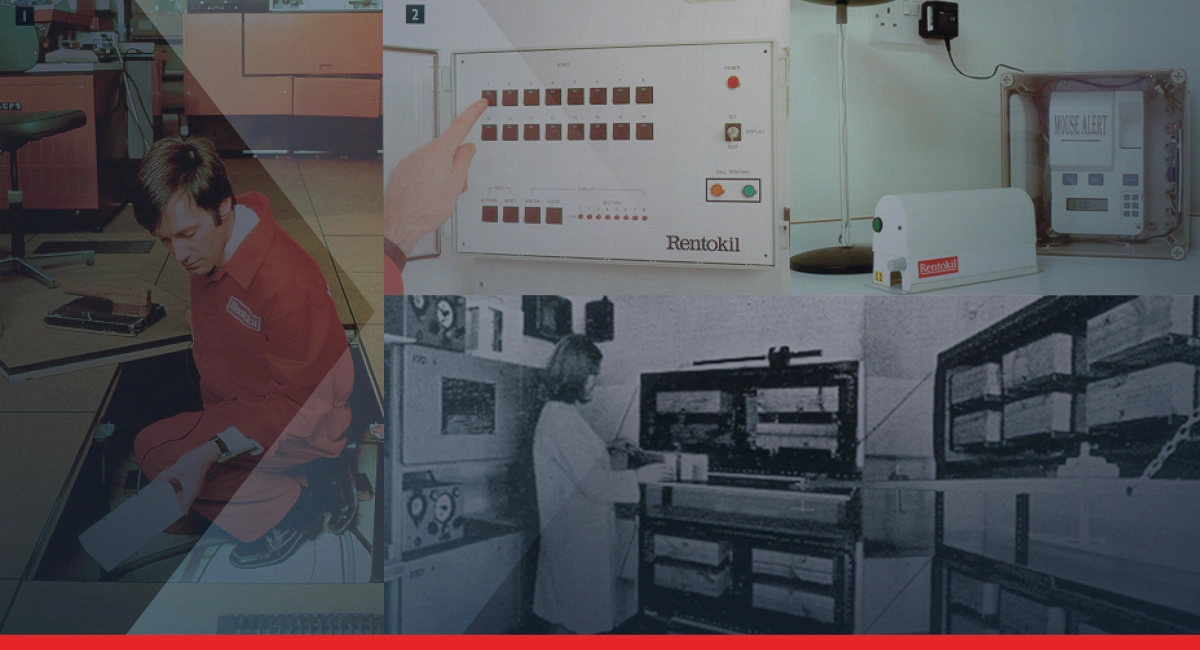
The advent of electronics brought ever-shrinking and more powerful computers, sensors and wireless communications. Combining these technologies, in 1992 Rentokil developed Mouse Alert, an electric mouse trap with sensors to trigger a shutter to contain the mouse, and wireless communications to relay the capture to a technician. In 2014 Rentokil launched the more advanced PestConnect system, which detects and captures mice and then releases CO2 to humanely dispatch them, sending data to a cloud-based system. This was one of the first pest control systems to use Internet of Things technology and Big Data analytics, combined with an online pest management system.
The discovery of UV vision in insects in the 1970s, and that UVA was the most attractive waveband to houseflies, led to the use of fluorescent UV tubes in electric fly killers (EFKs) and insect light traps (ILTs). They barely changed until about 2017 when LED technology had advanced sufficiently to outperform UV fluorescent tubes and Rentokil launched the Lumnia range of UV LED insect light traps.
The first industrial revolution, along with its major advances in science and technology took a couple of centuries. The pace of innovation is steadily accelerating and new discoveries can spread around the world in days instead of decades.
For over 100 years, Rentokil has been at the forefront of developments in pest control and continues to both innovate and adopt the latest innovations. But what will happen in the next few decades? Click here to discover where pest control is heading and get a glimpse into the future.
Round-the-clock digital pest management and monitoring