myRentokil
Manage your business
The humble insect light trap, an essential device for the food industry, has a surprisingly rich history. For over a century, this simple-looking device has been used by homes and businesses to control fly pests. But how did it all begin? And how has this technology evolved over the last 100 years?
In this blog, we'll delve into the fascinating history of the insect light trap, tracing its development from the earliest rudimentary models to the sophisticated devices Rentokil has developed today. We'll explore the scientific principles behind these traps and the various types of trap that have been developed.
One of the earliest devices that used electricity was patented in 1902 by ER Greene of Rhode Island, USA (Electric fly trap US Patent 698274). It consisted of a vertical wooden or hard rubber board wound with closely separated sets of positive and negative wires — as is still used in the traditional industry electric fly killers (EFKs) today. A fly landing on a wire would touch another of opposite polarity and be electrocuted. A spacer between the wires and the board was used to place an attractant, which was suggested to be a bar of lump sugar.
Figure 1. The first patented electric fly trap
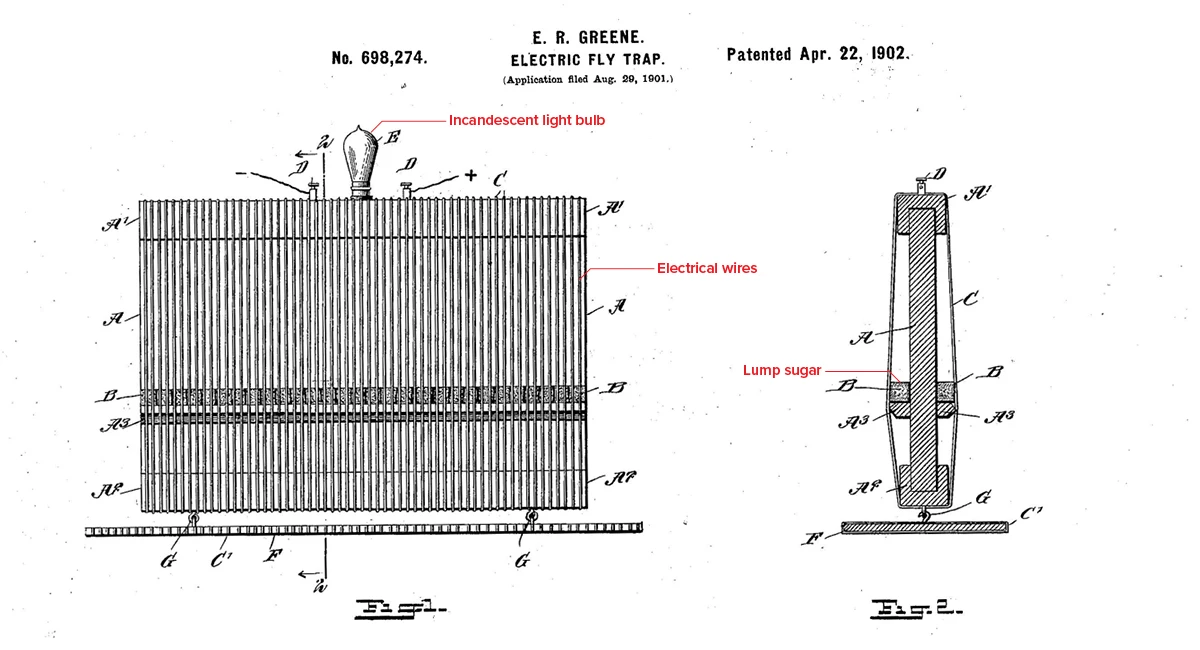
There was an incandescent light bulb on the top, not to attract insects but to prevent the fuse wires from burning out and to indicate when the wires were short-circuiting. The inventor described his device as “a new and improved electric fly killer especially designed for use in stores, kitchens, dining rooms and other places”.
The inventor obviously recognised the need to control pest flies, though the device was aimed at the home user. However, at the time, few people had electricity, so the market was limited to well-off people who were connected to a supply or had their own generator. We have no idea if it was successful or was ever produced commercially. It makes no claims about efficacy in catching flies or about the safety of the device. It may even have harmed more humans than flies, having unprotected wires connected to the mains!
Figure 2. An early caged electric fly trap
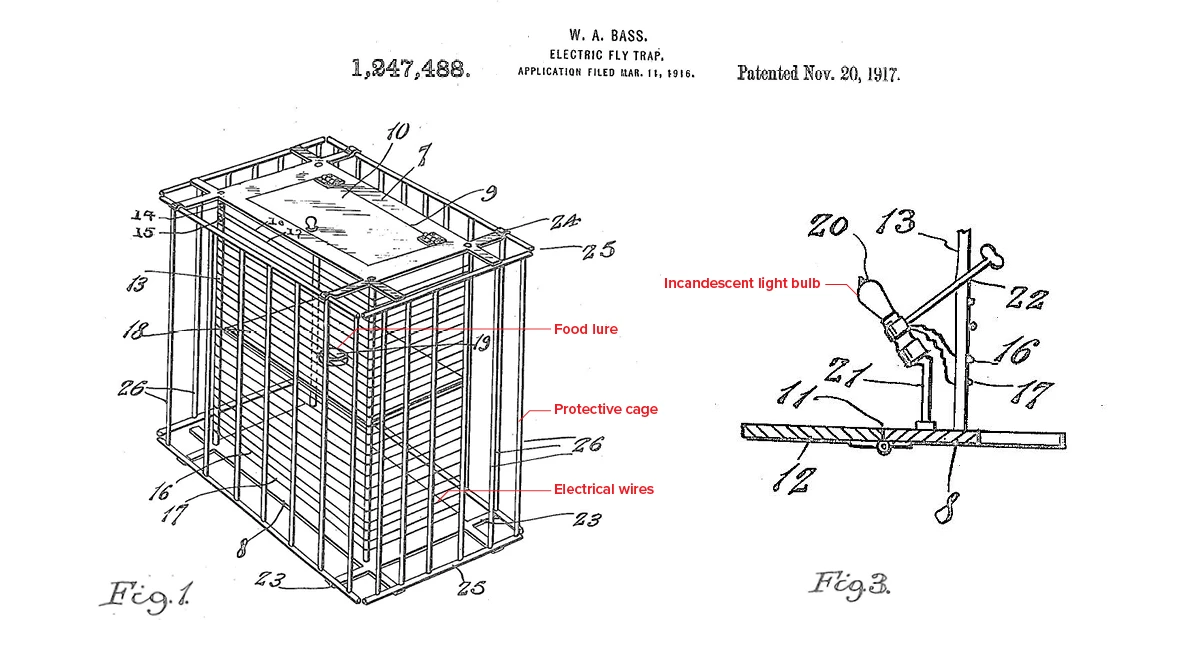
Various devices for controlling insect pests were produced in the following decades. Some look similar to EFKs that people have in their homes today. They had a bait in the middle to attract insects and some had a lamp to attract insects at night or in dark places. By at least 1917, the electrified wires were placed inside a metal cage to prevent users from touching the live wires (US patent 1,247,488). But there was still no mention of using light to attract flies, although this model had a small incandescent bulb attached inside the electrified grid, possibly for use at night. This may have been because incandescent bulbs at the time were not very bright, so they were of limited use in daylight.
In the 1930s, EFK developments were aimed at controlling insects outdoors at night to protect crops such as fruit trees from insect pests, as an alternative to spraying. The Folmer Chapin Corporation of New York filed a series of patents for an “insect exterminator” with first an incandescent and then a mercury vapour lamp as a lure for insects outdoors at night. The mercury vapour lamp was added because it was cooler and “certain insects such as the common house fly, while attracted to light, are repelled by the presence of heat” (US Patent 1,962,439). These types were not widely adopted because of the cost of running them and their ineffectiveness.
Although mercury vapour lamps were first developed in the late 1800s, and it was known that they produced UV light, it was not understood that UV light could be useful for attracting insects. The first practical mercury vapour lamps were mainly for commercial use, such as streetlamps, and for germicidal use (using UV-C light), which was already recognised in the late 1800s.
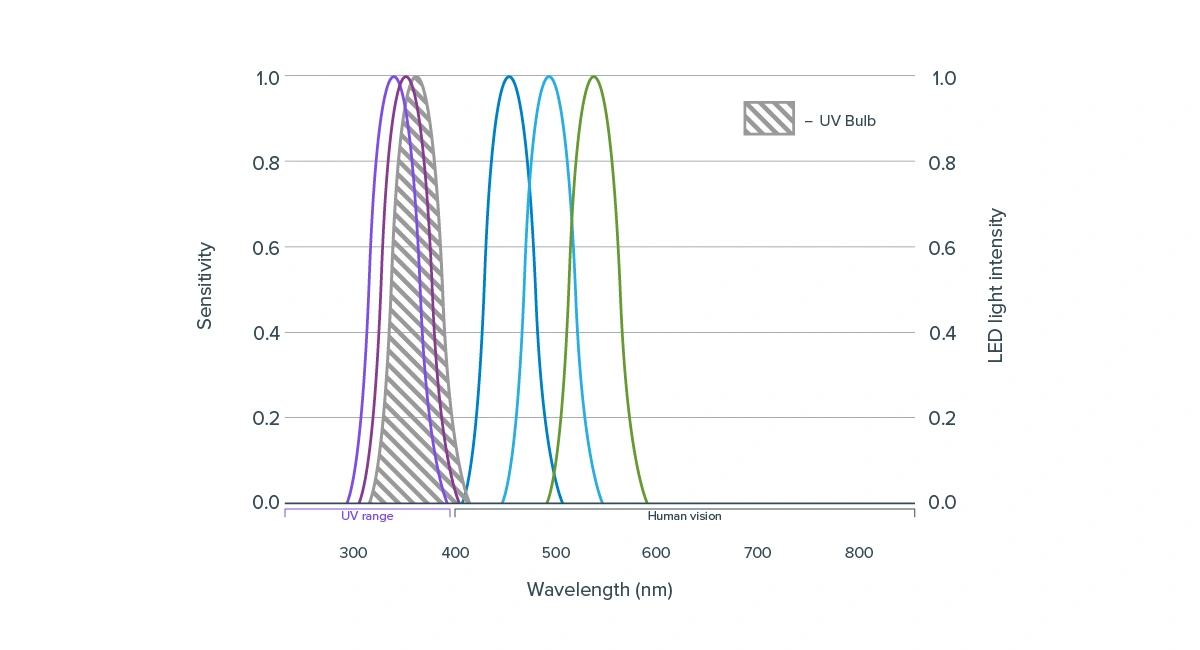
The UV sensitivity of insect eyes was not discovered until the 1970s, when 310–370 nm wavelengths, which are in the UV-A band (nearest to visible light), were found to be the most attractive to house flies. Later it was found that UV vision plays a role in foraging, navigation and mate selection in insects — and even in vertebrates such as birds, fish, mice and rats.
Light indoors is generated by incandescent, fluorescent and increasingly LED lamps, which all have little output in UV wavelengths (although fluorescent tubes produce UV light from the mercury vapour inside the tube, it is absorbed and re-emitted as visible light by the coating on the glass tube). The intensity of sunlight at the earth’s surface drops sharply at UV wavelengths — ozone absorbs UV-C — but it is still a strong source at UV-A wavelengths. House flies and fruit flies have light receptors that peak at two wavelengths in the UV-A spectrum and three in the visible spectrum (blue, cyan, green).
Figure 3. Light sensitivity of a house fly (Musca domestica) eye compared to the UV LED spectrum.
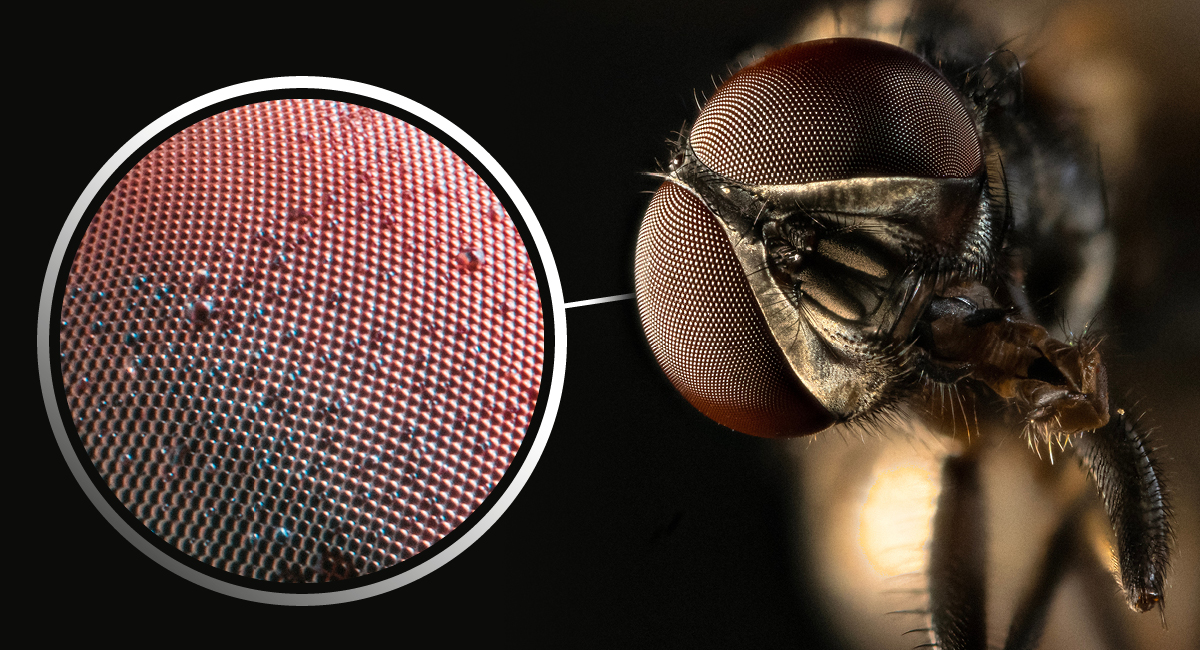
Fly eyes have specialised photoreceptors that detect light intensity across a wide range of wavelengths and flies are attracted to bright light. Flies have brain circuits that make them more attracted to UV sources of light than visible wavelengths. This is called the open-space response, which drives them to bright, open spaces with UV light and away from dim sites.
The lack of UV light in the indoor environment makes UV lamps stand out to flies and many other insect species, including bees, butterflies and some beetles that have UV photoreceptors. This has led to UV lamps becoming the main lure for house flies and biting insects.
Although they are popular among home users for controlling mosquitoes and other biting flies, UV EFKs are nearly useless for their control. Instead, they kill large numbers of beneficial insect species when used outdoors and are harmful to local ecosystems. A study of insects caught around homes by EFKs found only 31 out of 13,789 insects killed were biting flies (including mosquitoes). This is not surprising now we know that many fly species do not have UV light receptors.
The Minamata Convention on Mercury has led to a worldwide ban on fluorescent lamps, starting September 2023 in European countries. LED lamps are now an essential feature of ILTs and have other benefits such as lower energy use. The first commercial insect light traps using LEDs came on the market in 2017.
EFKs were not used in the food and pharmaceutical sector, which require high standards of hygiene and pest control, until the 1960s. The earliest models copied the design of those long used for outdoor and home use — a hanging cylindrical shape with a vertically placed fluorescent tube in the centre.
Figure 4. Some early EFK and ILT designs, from the 1960s and 1980s.

The requirements for effectiveness, safety and compliance with regulations made this design unsuitable. In the 1980s, the FDA code for retail food protection stipulated that only wall-mounted devices could be used, electrically charged parts must be guarded to prevent electrocution of people working nearby, devices had to be certified by a testing laboratory, and they had to be placed at least five feet from “exposed items”.
We now know that the risk of contamination extends beyond the range of visible scattered insect fragments. A systematic evaluation of EFKs found that the risk of contamination from fly-borne pathogens increased sharply when EFKs were turned on. Smaller particles remained airborne for long periods, which meant they could travel farther in air currents — just like an airborne disease! This makes EFKs (ones that electrocute insects) effective devices for spreading pathogens carried by flies and not suitable for use in high hygiene areas. The only solution is to trap the flies.
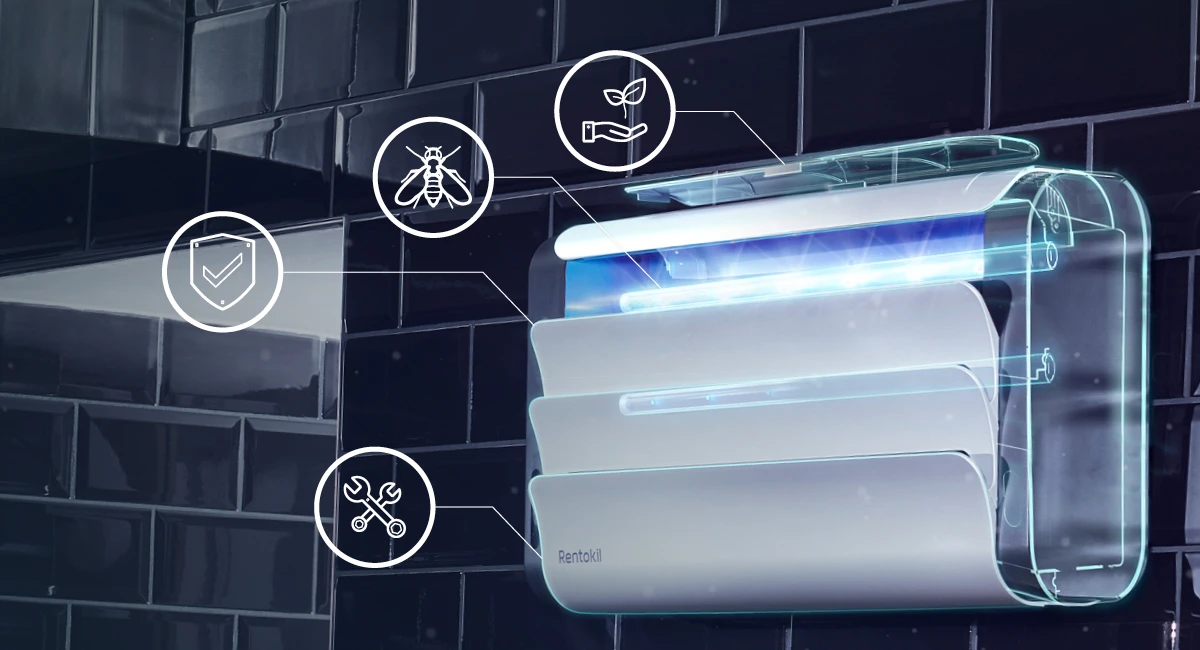
After decades of development, some basic design features of ILTs were fixed by scientific findings and regulations. The latest ILTs don’t look very different from early models from the outside, but there are multiple design features that are hidden to the untrained eye that make them more sustainable, efficient and effective for insect pest control.
To attract flies, there must be a high UV light output at the wavelengths that fly eyes are most sensitive to. The light must be brighter than its surroundings, so in bright light the UV output must be sufficient to attract flies, but in low ambient light the output of the lamp can be reduced while keeping effectiveness.
Capturing the insects whole, containing them and being able to dispose of them easily and safely is an essential feature for an ILT in high-hygiene business environments. Glueboards and rolls capture and contain flies, and glueboards can allow easy monitoring of the insect catch. Safety for food handling environments can be certified, such as with HACCP certification, to give assurance that the design is suitable for a business.
LEDs are safer than fluorescent tubes, with no mercury, glass and several other toxic chemicals that could contaminate the area and cause a hazard on shattering and require specialised waste disposal.
LED lamps give high UV output and use less energy than fluorescent lamps. LED lamps vary in UV output and energy use, so using high-efficiency and low-energy lamps is critical even for LEDs.
LED lamps last at least three times longer than fluorescent tubes, reducing the number of lamps going to waste, but LED lamps also need designing to optimise their life. LED lamps used in ILTs use less materials, which reduces waste, and they do not require specialised waste disposal treatment.
Sustainability issues include whole-life use of resources and the effect on the environment, from manufacture to disposal. All components of the device, consumables, servicing and whole-life carbon footprint should be considered. There is a range of certifications that give assurance to sustainability claims, such as the Planet Mark.
UV-A light from ILTs is generally considered safe for typical exposure levels, being far less than would be experienced outdoors, but the effects of long-term exposure are not known. In the interests of caution, it is better for an ILT to shield people from direct exposure to UV radiation by directing the light above head height using louvres.
An electrical device should be designed to be safe from damage by liquid or dust ingress, and there should be no risk of electrocution to people nearby in case of accidental water ingress. A rating of IP65 will give protection from dust and sprayed water.
Glueboards need to be changed periodically for monitoring insect pests and replacing them. The unit’s design should make this a safe and easy operation, including accessing and opening the unit and replacing the glueboard or roll.
This is important in environments such as hospitality front of house, where the ILT needs to fit into the decor of the surrounds and not stand out as a piece of industrial hardware that advertises there is an insect problem.
Developed with innovative, patented LED technology, our Lumnia range of insect light traps are designed to attract, kill and encapsulate insects hygienically