PestNetOnline
Login© 2026 Rentokil Initial plc and subject to the conditions in the Legal statement
The age-old battle against pests continues to evolve as technology develops, bringing many exciting possibilities. This opens up many opportunities for pest management experts to explore novel approaches that tackle and mitigate infestation risks while minimizing their impact on our planet.
From cutting-edge DNA analysis, which unlocks valuable insights into rodent behavior, to the innovative use of Fluorescent Tracking Gel and AI cameras that enhance the visibility of what’s happening at a customer site, reducing the chance of an infestation, we’ll explore a range of techniques that are revolutionizing pest control and helping companies to be more sustainable, unpacking what they mean for you.

DNA testing has long been used to understand the genetic makeup and ancestry of humans.
It plays a crucial role in various fields, from healthcare and law enforcement to genealogy and conservation, by providing valuable genetic information to inform decisions and solve complex problems.
But, consider if this DNA analysis could be applied to rodents to improve pest insights.
One potential ingenious system that may be made possible for the industry is a pioneering system that consists of DNA analyzing rodents to improve pest insights.
This approach would involve collecting fecal samples from rodents found in infested areas and analyzing their DNA to gain valuable insights into the rodent population’s characteristics and behaviors. For example, whether they carry genes associated with resistance to specific rodenticides.
It would allow pest control experts to identify the rodent species in a specific area and implement a targeted control strategy. This would mean quicker and more effective infestation control for our customers.
The novel system would also enable more targeted and effective baiting strategies. This is because of the enhanced knowledge of rodent species and their resistance, allowing for the most appropriate rodenticide and application methods based on the specific population.
This minimizes bait wastage and maximizes its impact on the target species, resulting in faster and more effective protection for our customers.

Artificial intelligence is introducing a new dimension to pest control. For example, Rentokil uses an intelligent rodent surveillance system that uses machine-learning technology for smart object detection to identify rodents and confirm rodent activity when there are few other signs.
This allows for enhanced visibility of what’s happening at a customer site, reducing the chance of an infestation and minimizing the need for rodenticides to control costly infestations.
It combines real-time images and machine-learning technology to help technicians respond quicker than ever. The system will also be fully integrated with our digital ecosystem, so customers can benefit from enhanced transparency and the ability to quickly view any identified activity on their Rentokil customer portal.
Customers will also benefit from similar systems for crawling and flying insects in the future. Photos would identify captured insects, enabling early environmental change warnings and precise counting for enhanced protection.
Learn more about our work with AI and cameras in the industry.
As the world becomes more eco-conscious, the demand for eco-friendly pest control solutions is increasing, including more environmentally friendly unconnected solutions.
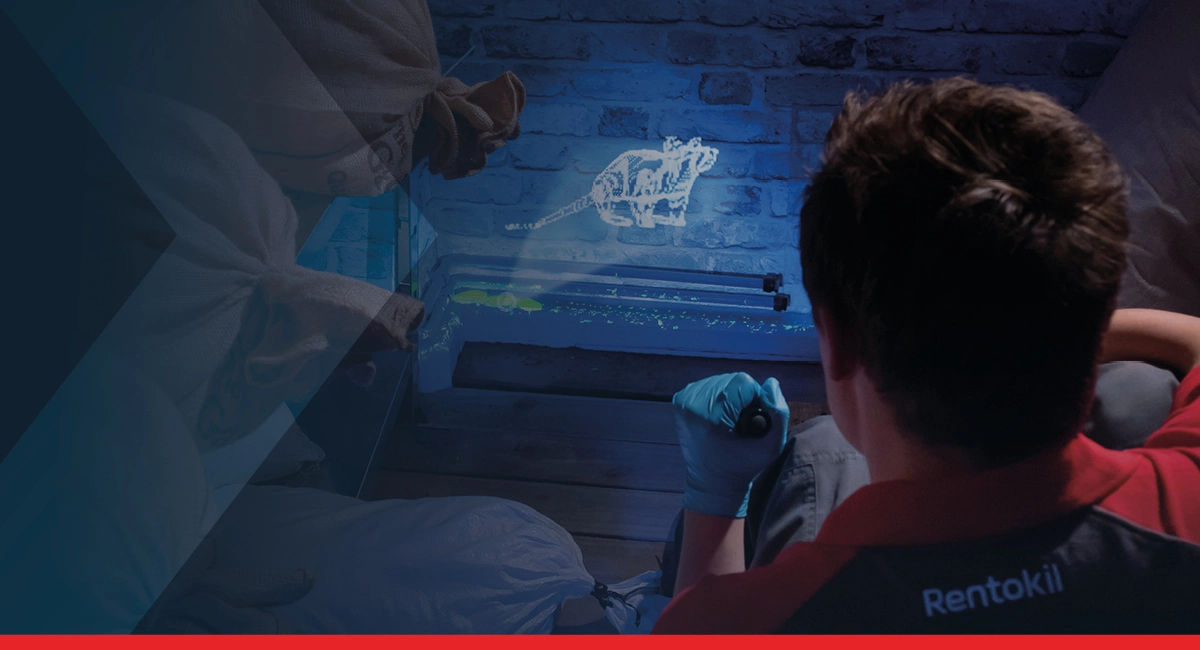
For example, our fluorescent tracking gel is a non-toxic gel that highlights rodent tracks on virtually any surface, enabling the blocking of entry and exit passages. It also allows precise placement of traps and bait, reducing the need for unnecessary chemical application.
The gel allows for more targeted, minimized, and strategic rodenticide use, and it enables quicker resolution as it’s easier to understand and identify rodents’ movement patterns.
Rodents are curious and agile creatures constantly squeezing through the tiniest gaps as they forage for food and shelter. Their intelligence and curiosity mean they’ll find a way through open entry points unless a building is securely proofed. Professionally proofing your premises prevents pest entry and costly and disruptive infestations.
Rentokil’s Flexi Armour range is one of the most effective rodent-proofing solutions available to protect the interior and exterior of buildings against rodents. The range consists of various products – such as Flexi Armour Seal to seal small gaps and cracks around your building and Flexi Armour Shield for an impenetrable barrier around the perimeter of buildings.
It focuses on prevention and proactively deters rodents, so it minimizes rodenticide usage and the risk of costly pest infestations. By combining proofing innovations with technology-enabled solutions like PestConnect, we can create an even greater sustainability impact with a highly humane, well-rounded, integrated pest management solution.
Many pests challenge businesses, but flies are undoubtedly among the most disruptive and require an effective solution to protect premises. Flies can transmit over 65 different diseases.
Lumnia® is the world's first LED insect light trap, offering a more sustainable option than traditional fluorescent bulb models. With four different models, there’s a Lumnia ILT to fit the unique needs of your business.
Lumnia catches flies up to 46% faster, on average¹, than competitor LED units and has greater coverage, protecting spaces of up to 2,690 sqft with a single unit². It achieves this remarkable efficacy, as Lumnia has saved 53,139 tons of CO2 – that’s equivalent to powering over 6,072 homes for a year.³
Furthermore, it even offers up to a 79% reduction in energy consumption4, making it one of the most sustainable insect light traps on the market, and helps businesses stay one step ahead of disruptive flies.
A challenge facing the pest control industry is the need to protect crops, buildings, and public health from pests while addressing broader concerns related to resource conservation, pollution reduction, and the mitigation of greenhouse gas emissions.
A potential pest control solution of the future, which we’re exploring, is an innovative approach to meeting this challenge – the possibility of turning waste into power. This next-generation thinking would mean we could use waste to power our connected products and foster sustainability with resource recycling.
Our connected products could harness renewable energy sources by converting waste to energy, mitigating greenhouse gas emissions. Furthermore, using waste as a resource would mean less material ends up in landfills, significantly reducing environmental pollution.

These are just a glimpse of some of the pioneering initiatives Rentokil is actively pursuing, and we’re already making progress across them.
The future of pest control looks incredibly promising, thanks to emerging innovations and technologies. By harnessing these, we can reduce our reliance on pesticides, mitigate environmental impact, and ensure a healthier future. As technologies continue to evolve, we can expect more groundbreaking solutions to emerge, further transforming the field of pest control.
¹Findings based on a controlled laboratory catch rate study conducted by Rentokil Initial in 2023 using the Lumnia Standard versus 5 competitor models
²Findings based on study conducted by Rentokil Initial in 2023 comparing max coverage area using Lumnia Standard model in a dark room versus the claimed max coverage area of competitor fluorescent bulb insect light trap units.
³Findings based on Lumnia range killowat-hour usage since launch vs. killowat-hour usage of 135 competitor ILTs in the last 3-4 years
4Findings based on comparison study conducted by Rentokil Initial in 2019 between Lumnia models (on Low Power Mode setting) and various fluorescent bulb insect light traps