For over 39 years we have protected properties from pests across Thailand
© 2026 Rentokil Initial plc and subject to the conditions in the Legal statement.
Biting insects feed on humans and animals by piercing skin to tap into a blood vessel. They actively seek a food source by using their various senses such as heat, smell and sight to find a suitable host. Some insects make a quick feed and leave while others prefer to find hidden areas of the body to stay till they are gorged and can only drop off when they are swollen with blood.
Find out how to identify and treat flea bites along with the diseases you can catch
Learn all about mosquito bites from identifying and treating them to the diseases mosquitoes bites can cause
Bed Bugs are on the rise again. Find out how to identify and treat bites from bed bugs
Whichever way they find a host and feed, however, biting insects can cause itching, inflammation, painful welts and in addition can transmit many serious diseases that affect millions of people across the world.
Find out which fly species bite, and how to treat and identify them
Mites are are closely related to ticks. There are nearly 50,000 known species, mostly microscopic, occupying a very diverse range of habitats. Many are pests of plants and animals such as bees and birds, but very few affect humans.
The house dust mite does not feed directly on humans but on shed skin particles and pet dander. The shed skins and faeces can cause allergic reactions in some people, similar to hay fever, asthma and eczema.
The scabies mite, Sarcoptes scabiei, is a parasitic mite about 0.5mm long that burrows into the outer layer of skin to feed on skin cells. It lays 10-25 eggs that hatch and emerge from the skin after 3-4 days to travel to another part of the body and repeat the cycle.
The infection results in itching caused by the body’s reaction to secretions from the mites. This can take up to eight weeks to appear.
Scabies is highly contagious. People living in the same household are likely to become infected easily.
The most common treatments for scabies are the pesticides permethrin, malathion and lindane. However, these can have side effects and should be used with advice from a medical professional.
Rickettsialpox is caused by the bacteria Rickettsia akari, which can be carried by house-mouse mites. They will seek new hosts, including humans, when the mice die off naturally or as a result of pest control. Infection is transmitted by the bite of the mite.
Rickettsialpox is regarded as a mild disease that takes 2-3 weeks to recover from. The first symptom is a bump around the bite that appears about a week after the bite, which turns into black crusty scab.
How identify crawling insects?
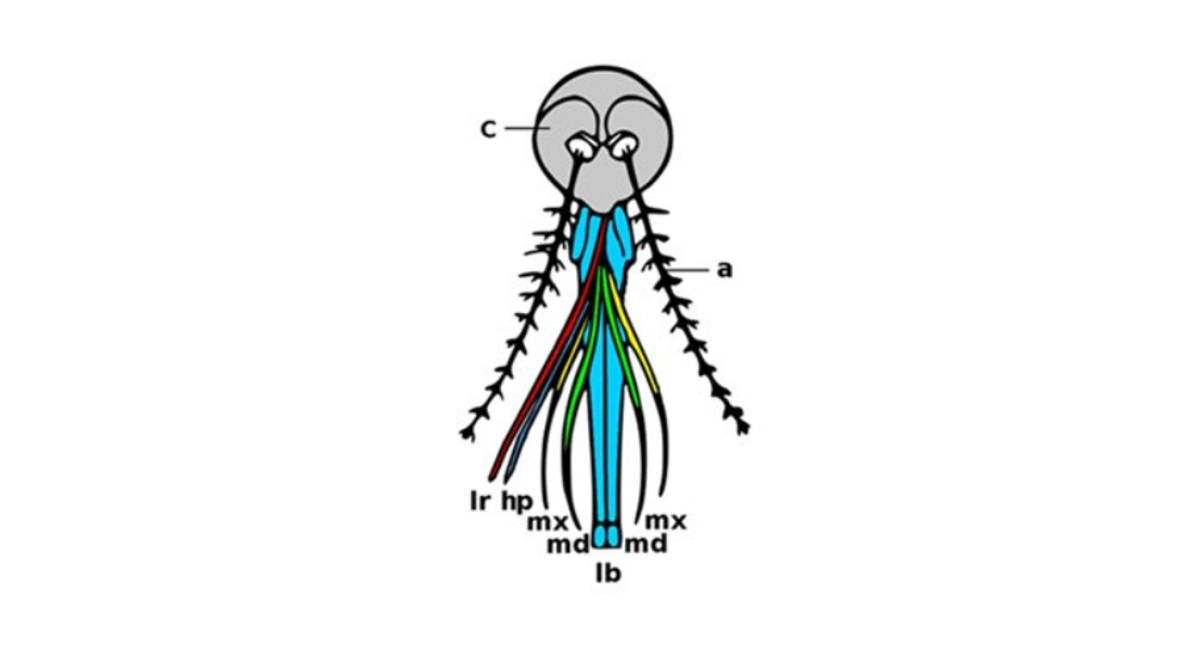
Legend:
a — antennae
c — compound eye
lb — labium
lr — labrum
md — mandibles
mx — maxillae
hp — hypopharynx
Source: Wikimedia commons: Xavier Vázquez.
People’s reactions to bites can vary greatly depending on the sensitivity of their immune system and whether they have been bitten before.
It can take hours or days for itching or redness to occur after being bitten, making it difficult to tell what bit you. In this case you will need other identifying factors to tell the source of the bite.
There are over 3,500 known species of mosquito worldwide and a large number of these transmit diseases that affect more than 700 million people each year, causing at least two million deaths.
Only the female mosquitoes need a blood meal, having the specialised mouth parts that can penetrate animal skin, though they can also feed on sweet plant juices.
Male mosquito mouth parts are adapted only to feed on nectar and plant juices and cannot penetrate skin. It is the females that transmit diseases to humans and animals.
The female mosquito finds a host by sensing carbon dioxide in breath, perspiration and body odours, and tends to feed in the evening and night time, though there are notable exceptions.
Mosquito bites are characterised by itchy red bumps on the skin, with varying degrees of swelling, depending on the person’s immune response.
How to prevent mosquito bites:
How to treat mosquito bites
Mosquito bites can be treated with some simple measures:
One of the main concerns around mosquito bites, is their ability to spread the following diseases:
Find more information on insect-borne diseases.
Find out how to get rid of mosquitoes
Mosquito prevention tips such as removing standing water
The term midge and gnat is a very general term for a wide range of flies, including the Sand fly and Black fly. Most are aquatic during the larval stage.
It is important to note that not all flies bite, some go about their day to day lives without the need to feast on humans. However there are a few fly species which rely on our blood to survive, these are:
How to treat fly bites
The bites of some flies such as horse flies can bleed. In this case a simple plaster applied after the bite has been washed would help. If the bleeding doesn’t stop on its own, you should see a doctor.
How to prevent fly bites
Find out more about the Insect Light Trap by Rentokil
Learn how to spot the signs of a fly infestation
Out of an estimated 160,000 species of moth there is only one genus, Calyptra, that can bite animals to drink their blood.
There are around 19 species of the moth, which are commonly called vampire moths, but just one species is known to have the ability to pierce human skin: Calyptra thalictri.
Unlike mosquitoes, only the male moth is known to have the ability to drink blood.
There are few reports of the moth biting humans and the only known case of the moth drinking human blood was in a test by the Russian scientist Vladimir Kononenko in 1999.
This species is native to areas as disparate as Thailand, the Urals and southern Europe.
In 2007 several newspapers reported recordings in Finland and later in Sweden. It is not thought to pose any risk to humans.
Find out how to get rid of moths
Discover how to identify a moth infestation
