150808 Contact us Request a callback

Stored product insect species

Stored product insects not only cause damage to food and raw materials but can also contaminate finished products. This contamination can render products unsuitable for use or distribution, leading to financial losses and negatively impacting your business reputation.

Here are the most common types of stored product pests found in Indonesia:

Find detailed information about the appearance, life cycle, and habits of each type of stored product pest below.
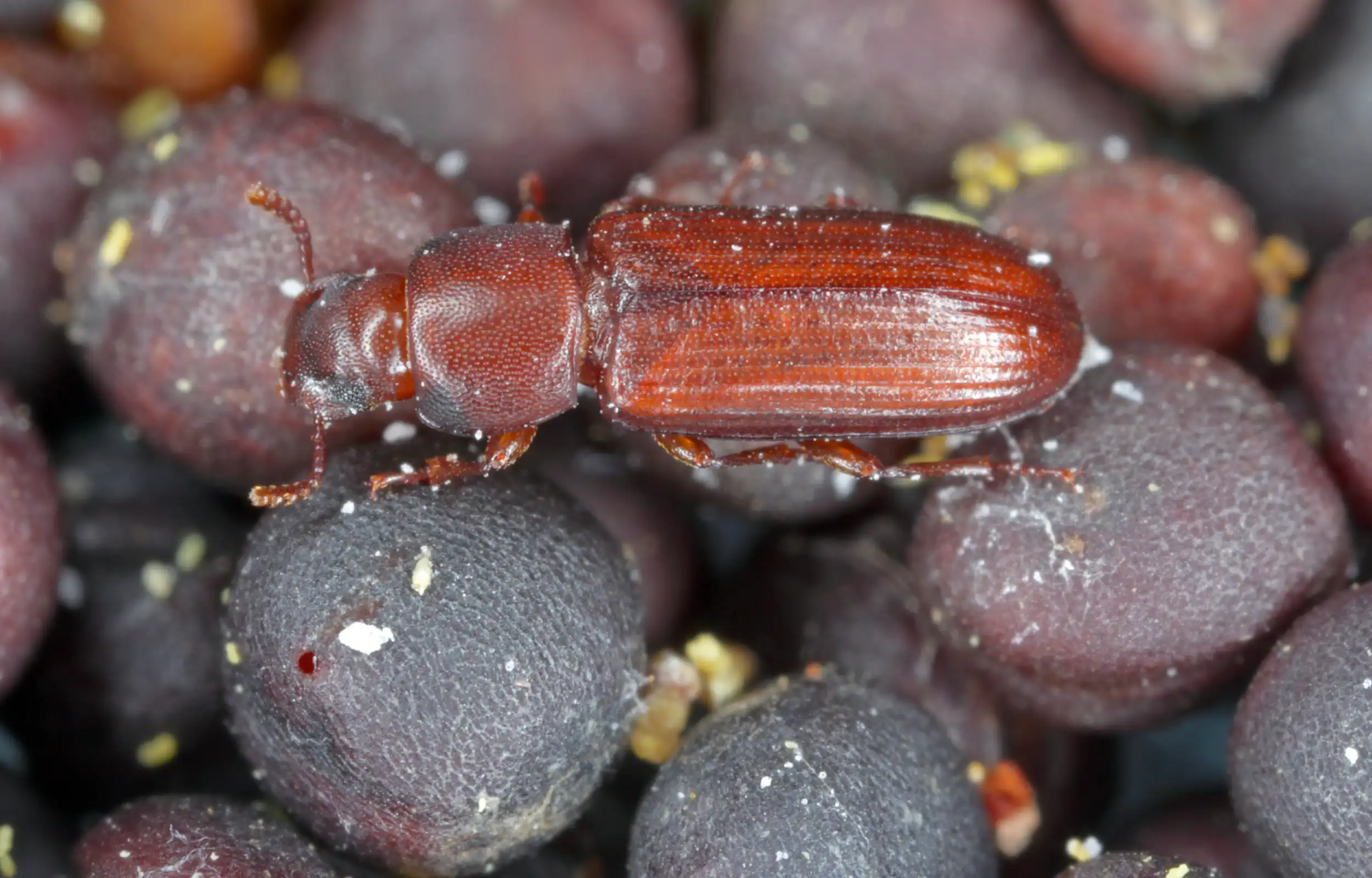
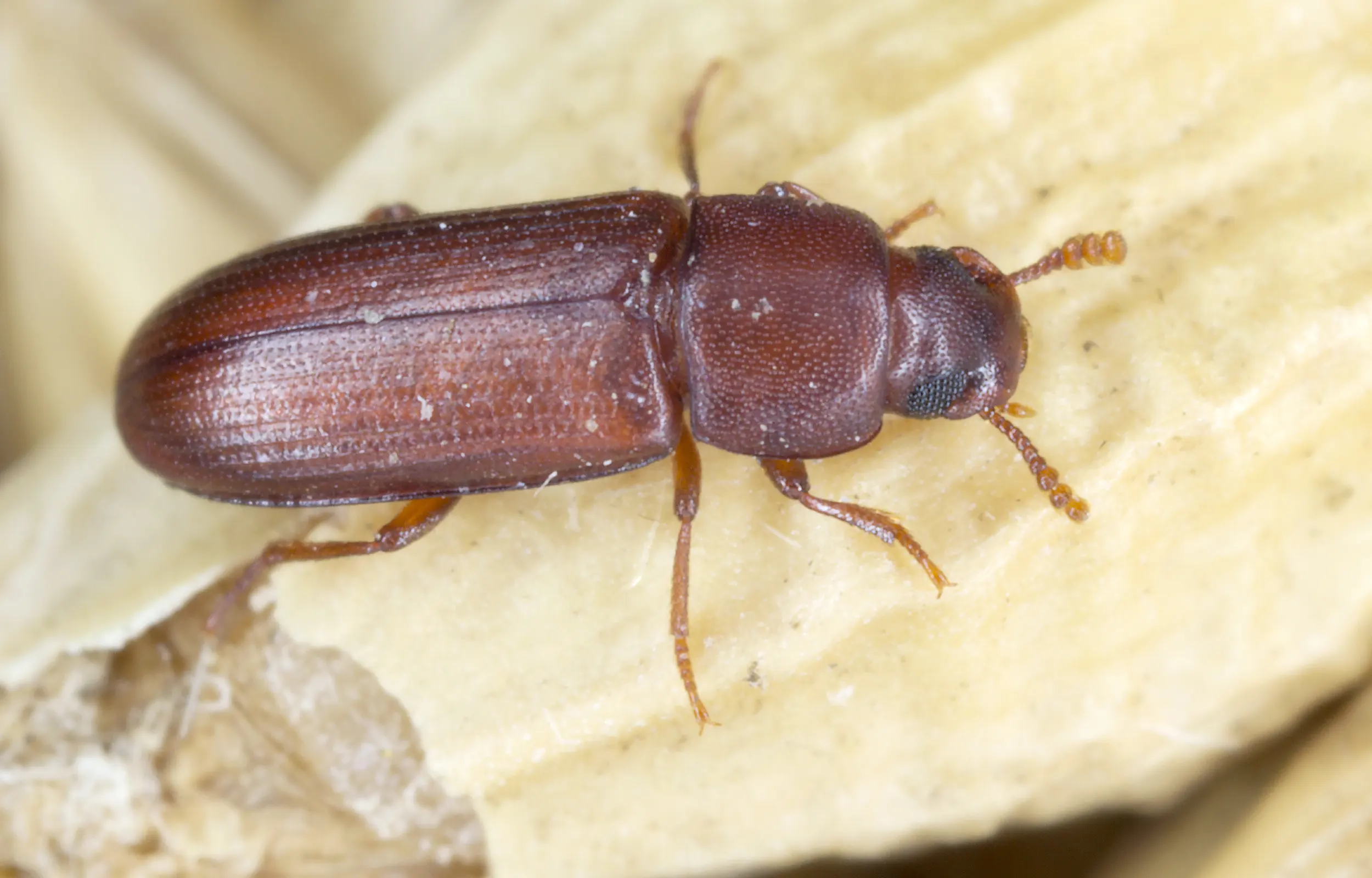
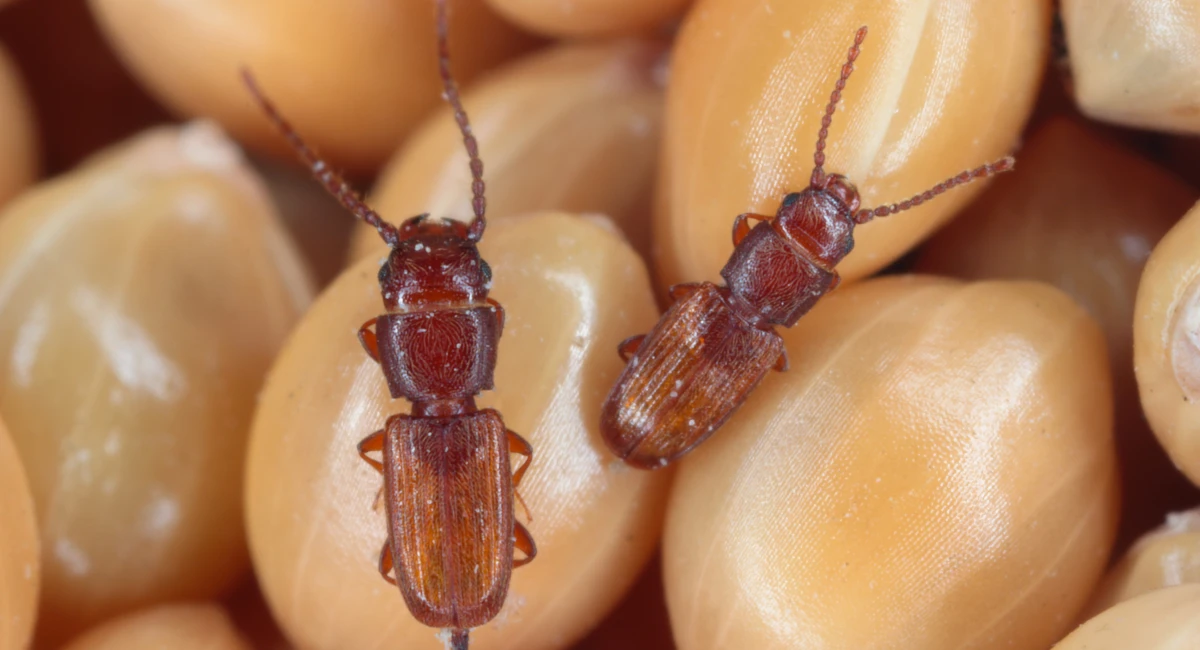
Confused flour beetle

Confused flour beetle

Tribolium confusum

  • The confused flour beetle is 3 - 4 mm in length, the larvae are about 6 mm long.
  • The adult is red-brown in color and the larvae are a light honey colour and about.
  • It resembles the rust-red flour beetle, except for the antennae which is four segmented and gradually thickens towards the tip - another slight difference is in the shape of the thorax.
  • The sides of the rust-red flour beetle are curved, whereas the thorax of the confused flour beetle is straighter. It has well developed wings but seldom flies.

  • Female lays between 400 - 500 eggs, with peak oviposition occurring during the first week.
  • Adults may live longer than 3 years, and females may lay eggs for more than a year.
  • Eggs are deposited directly in flour, other food material, or attached to the surface of the container. They are white or colorless and covered by a sticky material to which flour can adhere.
  • Eggs hatch in 3 - 5 days at 32 - 35°C. Larvae burrow into kernels of grain but may leave their burrows in search of a more favorable food.

  • Feeds off grain, flour, and other cereal products, beans, cacao, cottonseed, shelled nuts, dried fruit, dried vegetables, drugs, spices, chocolate, dried milk and animal hides.
  • They cannot feed on whole grain, but can feed on broken kernels that are usually present.
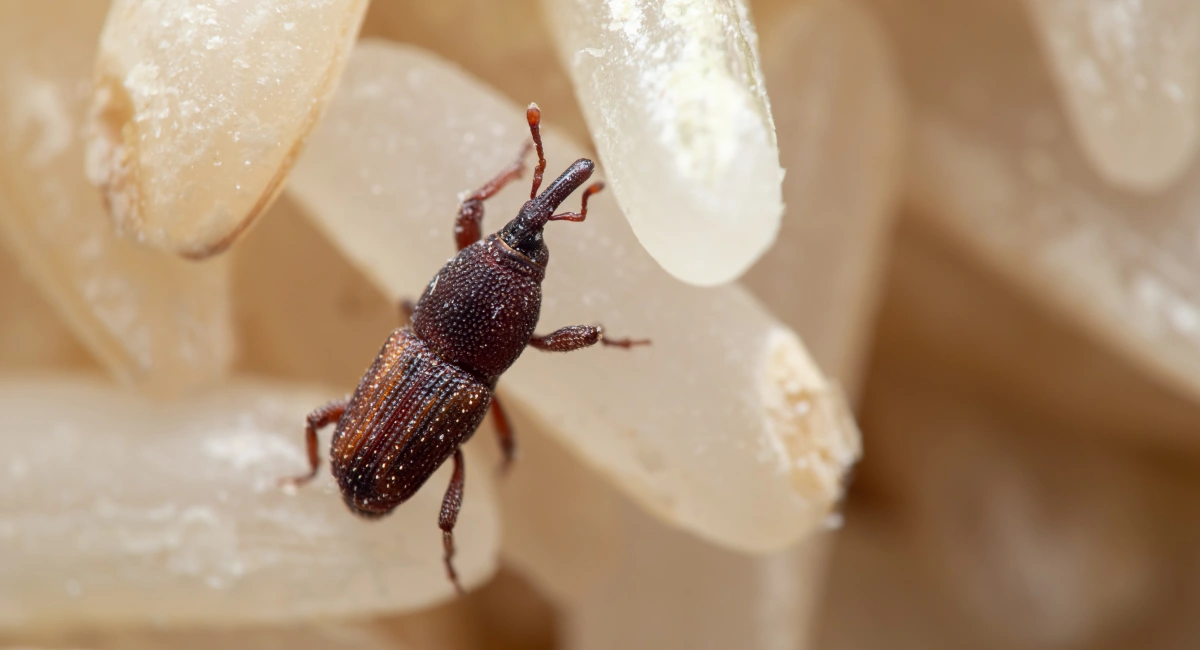
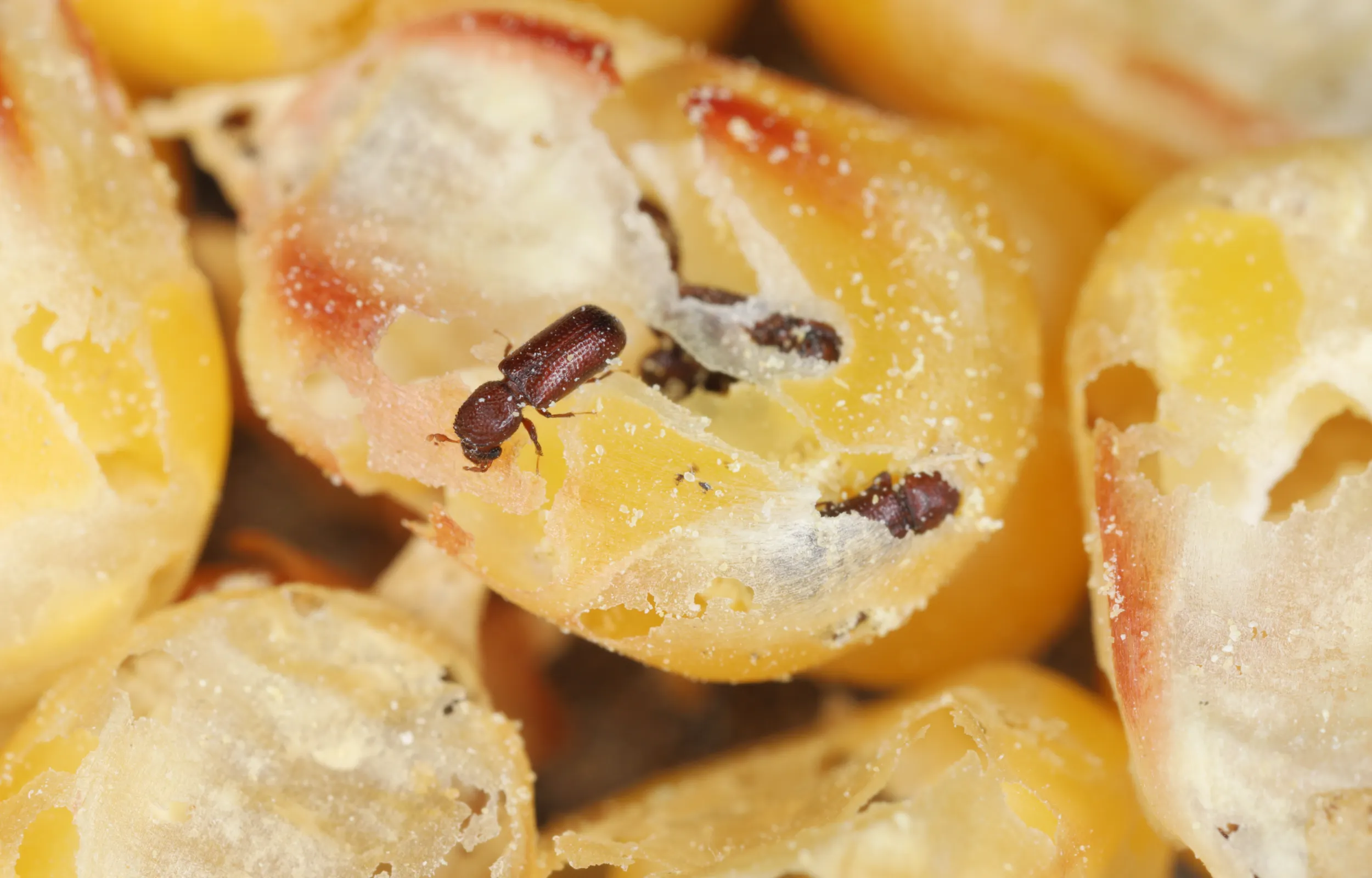
Rice weevil

Rice weevil

Sitophilus sp.

  • The adult rice weevil is 2.5 - 3.5 mm long and has a slender, hard-shelled bodies that appear pitted or scarred with tiny holes.
  • They are brown-black in color and possess a long slender snout.
  • Rice weevils have four faint red-brown spots on the back of the abdomen.

  • The adults live 3 - 6 months, infesting grain in the field.
  • The egg, larva, and pupa stages of these weevils occur in the grain kernels and are rarely seen.
  • Females drill a tiny hole in the grain kernel, deposit an egg in the cavity, then plug the hole with a gelatinous secretion.
  • The egg hatches into a young larva which bores toward the center of the kernel, feeds, grows, and pupates there.
  • New adults bore emergence holes from the inside, then leave to mate and begin a new generation.
  • Female rice weevils lay between 300 - 400 eggs, with the life cycle requiring about 32 days for completion. Two larvae can develop in one wheat kernel.

  • The adults can feign death by drawing up their legs close to the body, falling, and remaining silent when disturbed.
  • Emergence holes of the rice weevil are smaller than those of the granary weevil, and tend to be smooth and round.
  • There is generally no external evidence that the larvae have been eating and growing inside the seed until after about one month when the adult weevil chews through the seed coat and emerges.
Tobacco beetle

Tobacco beetle

Lasioderma sp.

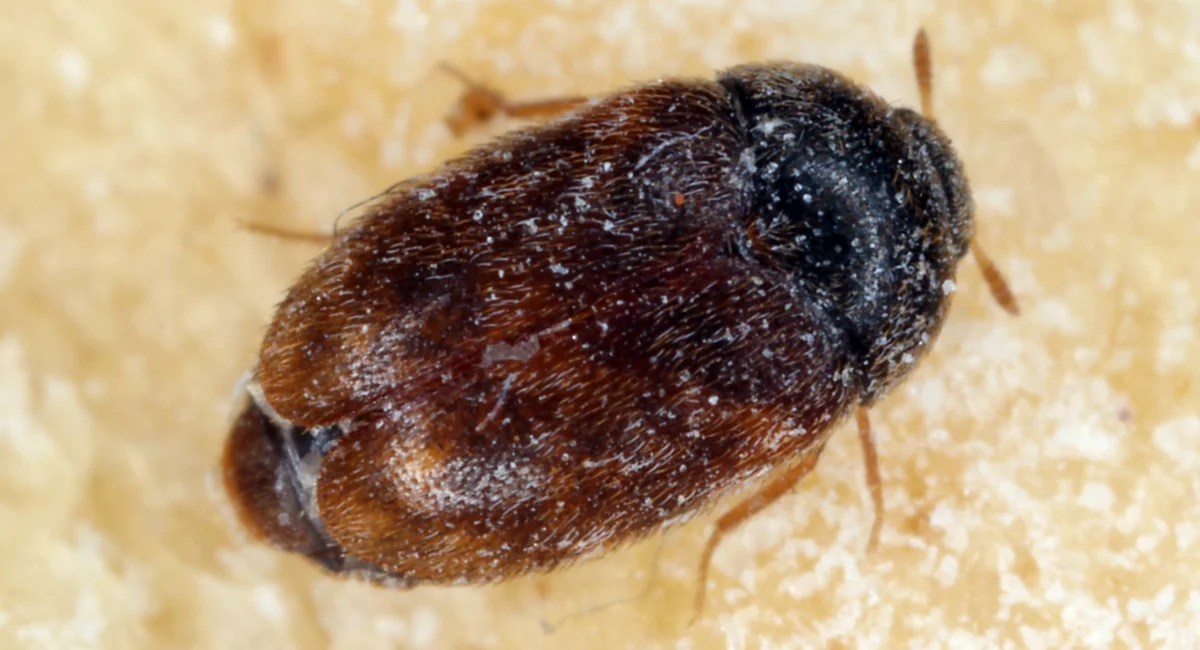
  • The cigarette beetle is about 2 - 4 mm in length.
  • The adult is whitish in color, with the head dark brown to tan, and are densely haired.
  • The cigarette beetle closely resembles the drugstore beetle.
  • The cigarette beetle has the head bent down nearly at right angles to the body giving it a humped back appearance when viewed from the side.
  • The larvae are about 4 mm long and somewhat bent.

  • The adult beetles live from 2 - 4 weeks and during this time the females may deposit between 10 - 100 eggs.
  • The eggs are laid loosely on the infested material.
  • The larval period usually ranges from four to five months, but under very favorable conditions the development from egg to adult may occur in 6 - 8 weeks.
  • When the larvae are fully grown, pupation occurs and they remain in this resting stage for 12 - 18 days.

  • The cigarette beetle feeds off tobacco, dry stored food products, spices, seeds, grains and dried plant material.
  • They have also been reported in rice, dried potatoes, paprika, raisins, grain-based mouse bait and dried straw flowers.
  • Adult beetles often wander away from infested materials and may be found throughout the area.
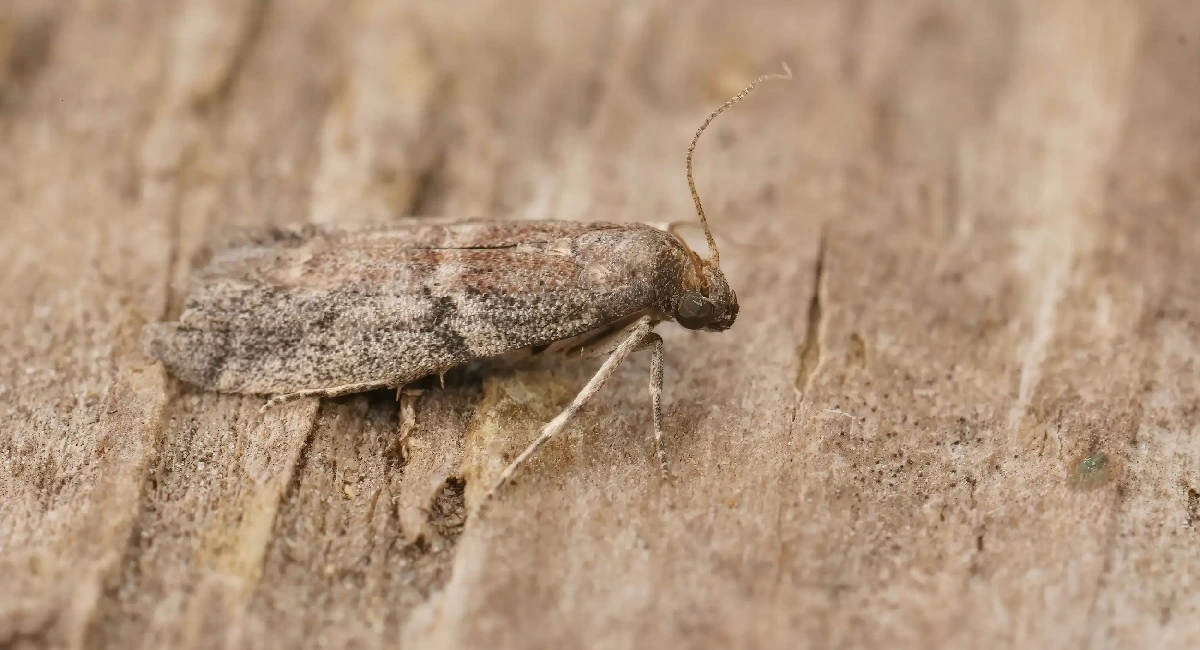
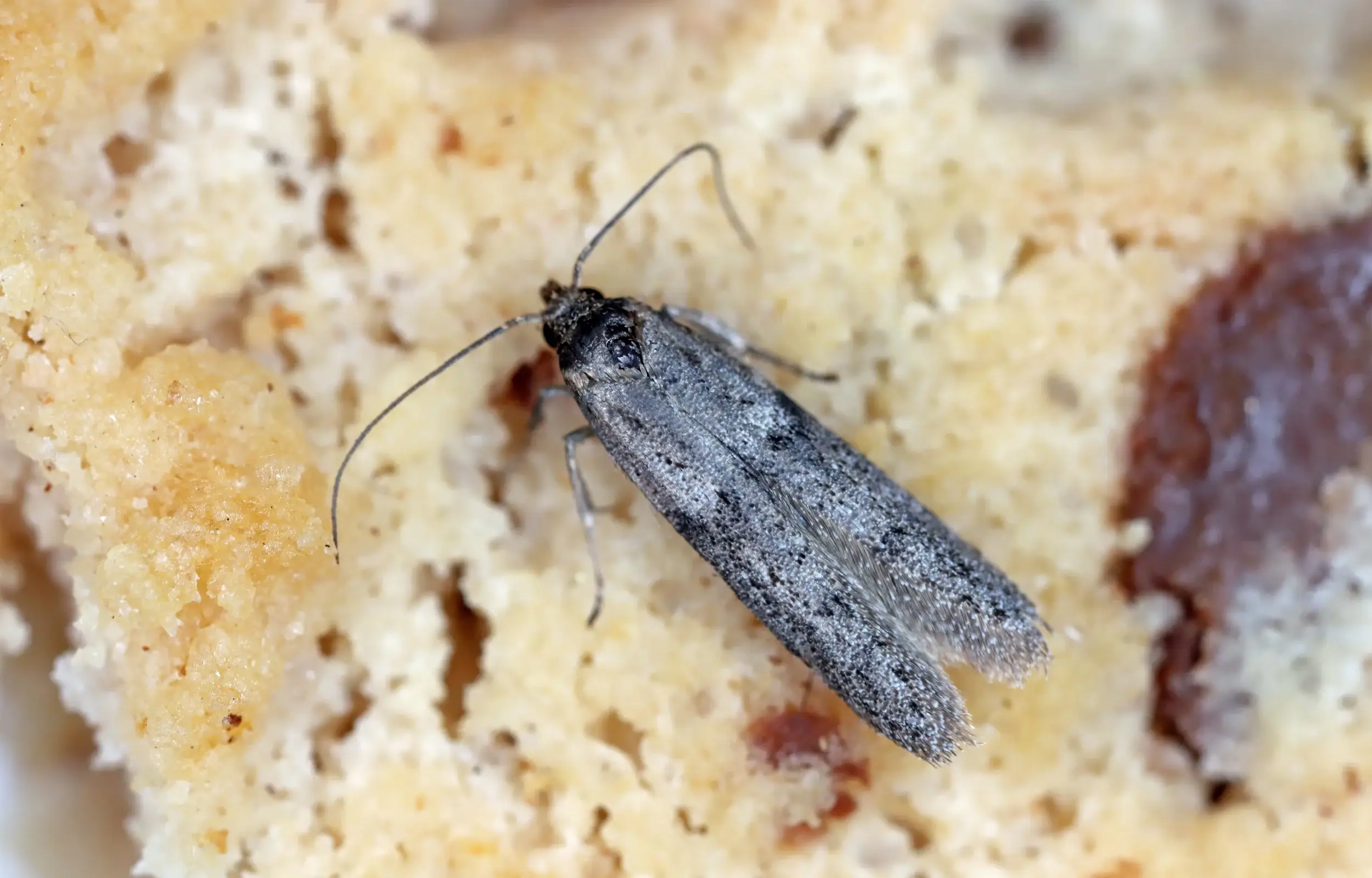
Cacao moth

Cacao moth

Ephestia elutella

  • Cacao moth are about 10 - 14 mm long as adults, with wings spread wide.
  • They have small bodies, ranging in color from gray to dark brown, with wings featuring distinctive stripe or spot patterns.
  • The larvae are creamy white with brown heads, measuring approximately 12 - 15 mm when fully developed and are commonly found in infested food materials.

  • Female cacao moth can lay 200 - 300 eggs throughout their lifespan.
  • The complete development from egg to adult takes about 30 - 50 days, depending on environmental temperature and humidity.
  • Females lay their eggs on surfaces or in cracks of dry food materials such as cocoa, spices or grains.
  • The larvae feed on the infested material, growing to about 12 - 15 mm before pupating.

  • The larvae are more active in causing damage, while adult moths are often seen flying or landing around food areas.
  • Their larvae feed on dry food materials such as cocoa, grains, spices and flour, burrowing into and damaging these products from within.
  • Adult beetles can fly and spread to surrounding areas, often found near infested materials, particularly stored food products.
  • Cacao moths are more active at night, preferring dark, damp environments for breeding.
Red flour beetle

Red flour beetle

Tribolium castaneum

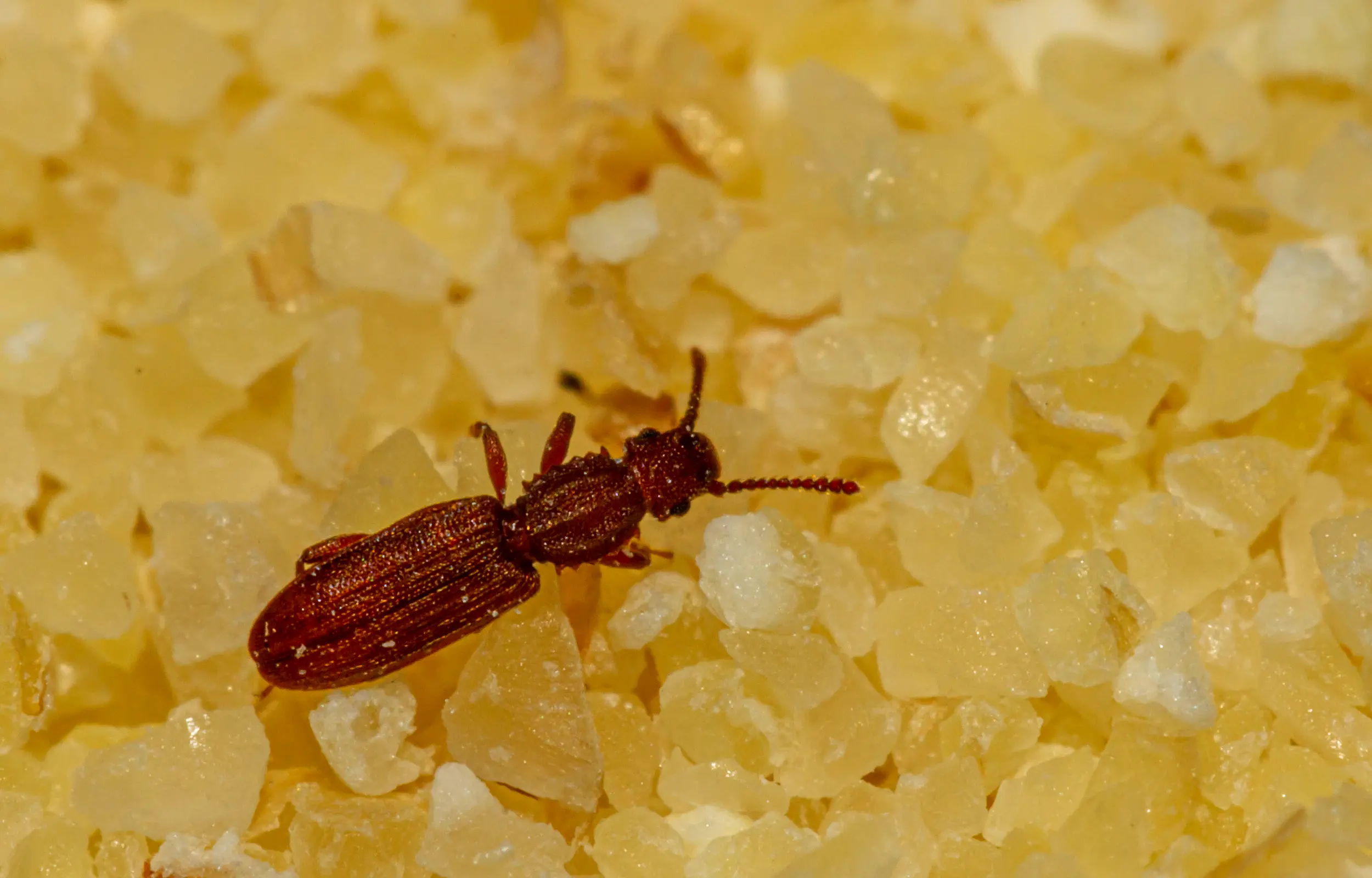
  • The red flour beetle is red-brown in color with 3.0 - 4.0 5mm in length.
  • The antenna of the red flour beetle is distinctly club-like, with a three segmented club and it has grooved wing covers.
  • The red flour beetle has well developed wings and has been observed to fly.
  • The larvae are a light honey color and about 6 mm long.
  • The head and a distinctive forked process at the tip of the abdomen are slightly darkened.

  • The female lays approximately 400 - 500 eggs, with peak oviposition occurring during the first week.
  • Adults may live longer than 3 years, and females may lay eggs for more than a year.
  • Eggs are deposited directly in flour, other food material, or attached to the surface of the container. They are white or colorless and covered by a sticky material to which flour can adhere.
  • Eggs hatch in 3 - 5 days at 32 - 35°C. Larvae burrow into kernels of grain but may leave their burrows in search of a more favorable food.
  • Larvae are fairly active but generally hide within the food, away from light.
  • Development time from egg to adult varies with conditions, however the average is 26 days at 32 - 35°C and >70% relative humidity.

  • When agitated or crowded, they may secrete chemicals called quinones. These chemicals can cause the infested feed to turn pink and have a pungent odor.
  • They have been reported in grain, flour, and other cereal products, beans, cacao, cottonseed, shelled nuts, dried fruit, dried vegetables, drugs, spices, chocolate, dried milk and animal hides.
  • They cannot feed on whole grain, but can feed on broken kernels that are usually present.
  • In general, fungi may play a significant role in the nutrition of red flour beetles.
Almond moth

Almond moth

Cadra cautella

  • The body is 7.5 - 10 mm long.
  • The adult almond moth has a wing span of 19 mm.
  • The forewings are grey to dusty brown.
  • The larva is white to pink in colour and has a distinctive brown head.
  • There is a dark straight band across the forewing, which is paler on the inner edge.

  • The female lays 150 - 200 eggs loosely and randomly on a food source.
  • The larva can grow to 12.7 mm in length.
  • When the larva is mature, it will actively leave the food source and search for a site in which to pupate.
  • The larva pupates in a silk cocoon.

  • The almond moth is found worldwide in processing facilities, warehouses and households.
  • It feeds on grain, cereal products, oilseeds and dried plant products, like nuts, fruit and tobacco.
  • The larva burrows into food and creates silk tunnels in which it will be concealed while feeding.
  • Large larva can burrow through packing.
Lesser grain beetle

Lesser grain beetle

Rhyzopertha dominica

  • The lesser grain borer is black-brown in colour.
  • It is about 2.5 - 3 mm long.
  • The body has a slender cylindrical form and the head is hidden under the round neck-shield.
  • The larvae are whitish with a yellow head.

  • Adult females lay eggs singly or in groups of up to 30 eggs.
  • The eggs are laid on the outside of the grain and a female can lay from 300 - 500 eggs.
  • In hot summer conditions it may take as few as 30 days, but the average is about 58 days.
  • Pupation takes place inside the hollow shell of the seed or in the "flour" that accumulates with infested grain.

  • The lesser grain borer is primarily a pest in stored wheat and corn.
  • It can infest tobacco, nuts, beans, bird seed, biscuits, cassava, cocoa beans, dried fruit, peanuts, spices, rodenticide baits as well as dried meat and fish.
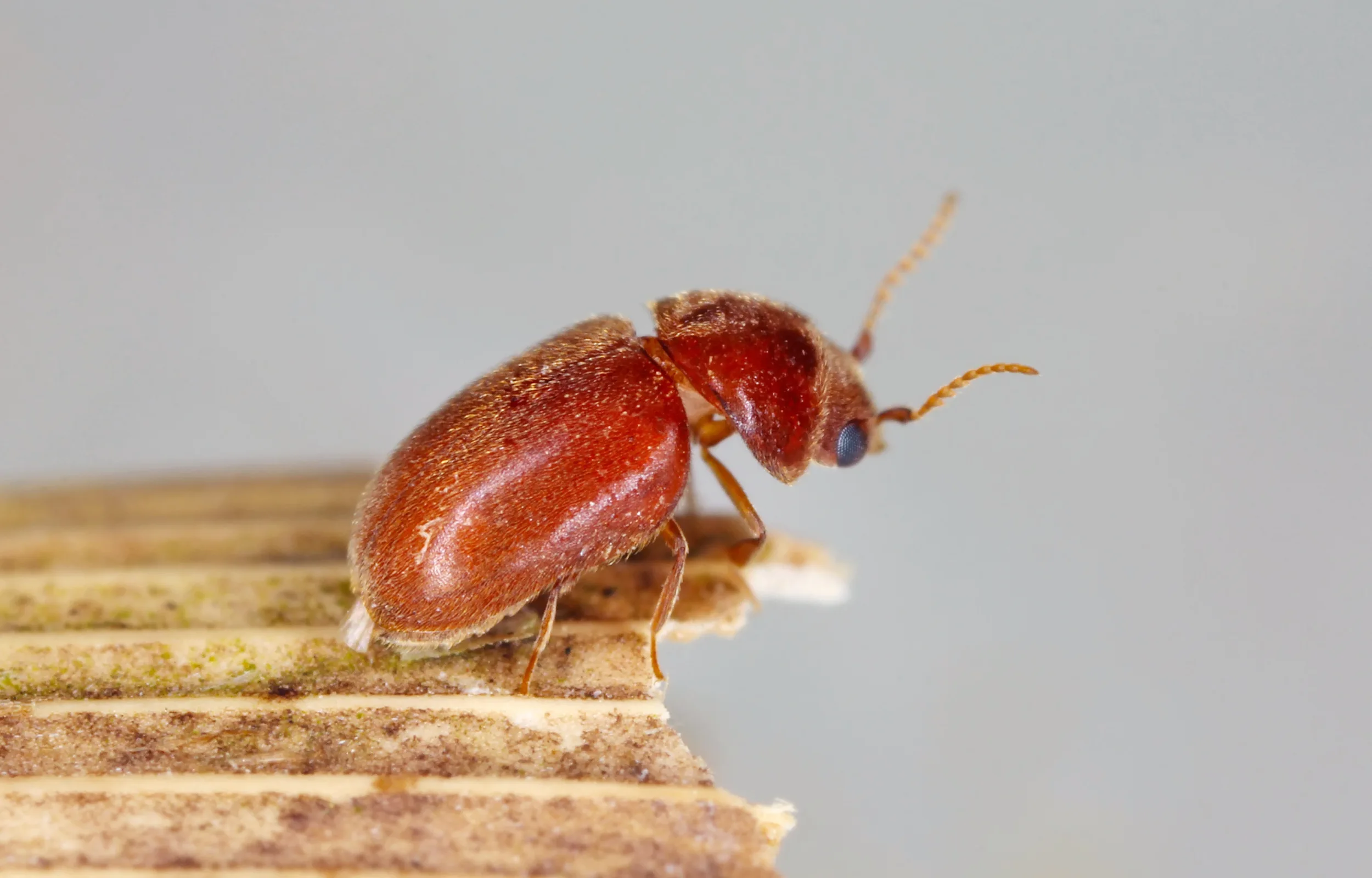
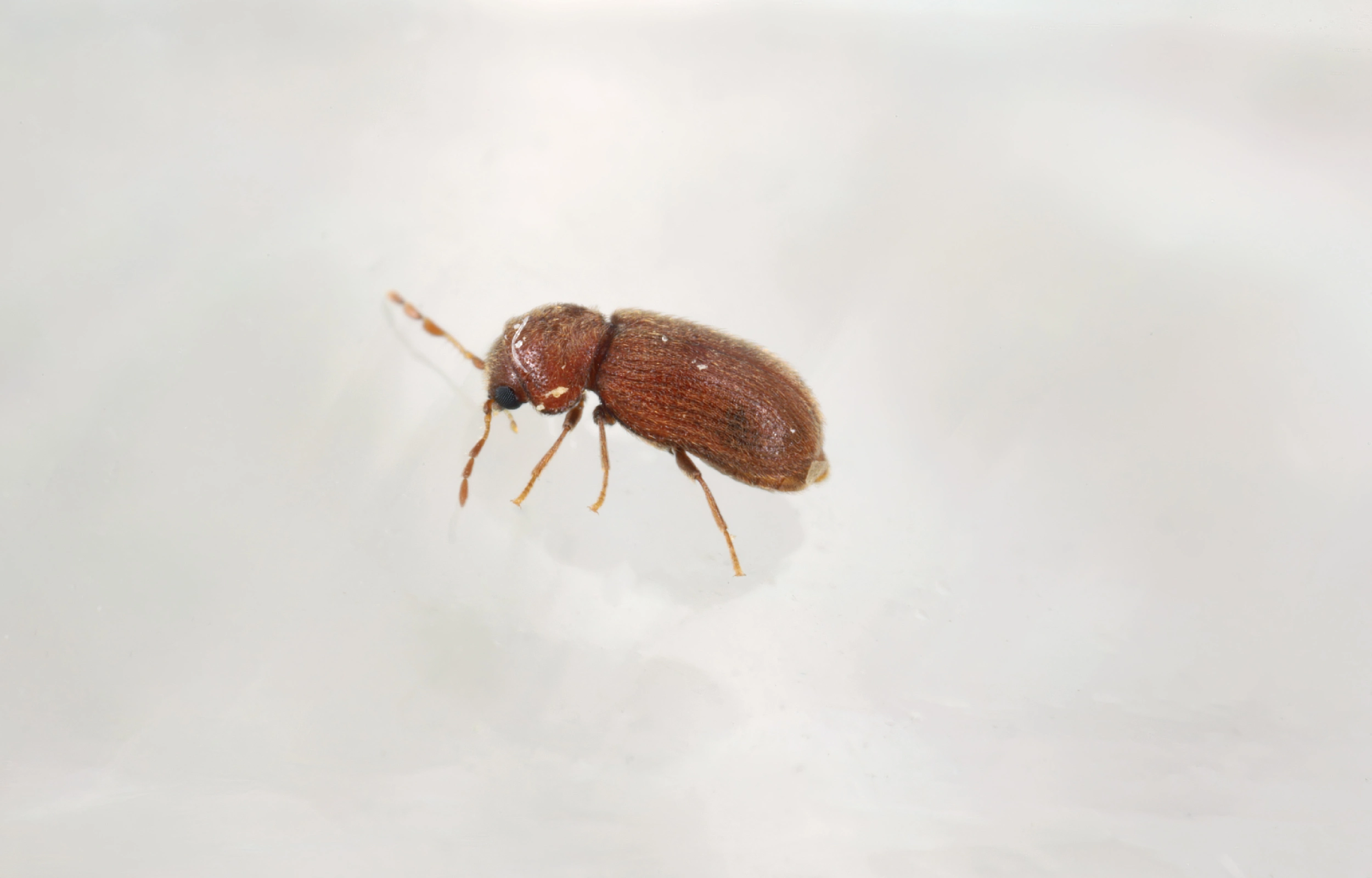
Drugstore beetle

Drugstore beetle / Biscuit beetle

Stegobium paniceum

  • Approximately 3 - 4 mm long, red-brown and oval beetles.
  • The larvae are small and white approximately 0.5 mm long.
  • The drugstore beetle is a red-brown oval-shaped beetle.

  • The adult beetles live from 2 - 4 weeks and during this time the females may deposit between 20 - 100 eggs.
  • The hatching larvae are 0.5 mm long and very mobile.
  • The larval period usually ranges from four to five months, but under favorable conditions the development from egg to adult may occur in 6 - 8 weeks.
  • When the larvae are fully grown, pupation occurs and they remain in this resting stage for 12 - 18 days.

  • It is not a major pest in stored grains but will attack spices, seeds, grains and dried plant material as well as packaging materials such as paper and cardboard.
  • They have also been known to feed on leather, wool, hair and books.
  • Their presence can be detected from pinhead holes in the infested items.
  • Packaging materials such as paper and cardboard are also attacked.
  • Since the drugstore beetle can fly well, the source of infestation can sometimes be hard to find.
  • The drugstore beetle is not a major pest in stored grains.
Rusty grain beetle

Rusty grain beetle

Cryptolestes ferrugineus

  • Adult is 1.5 – 2.5 mm in length. 
  • Red-brown in colour with flat body.

  • Female produces up to 200 eggs. 
  • In ideal temperature conditions, the life cycle is about 23 days.

  • Adults walk with a characteristic swaying movement. 
  • Adults are winged but rarely fly. 
  • Feeds on cereals, dates, dried fruits and other materials.
Saw-toothed grain beetle

Saw-toothed grain beetle

Oryzaephilus surinamensis

  • Adult is brown and is about 2.5 - 3 mm.
  • Mature larva is yellowish white.
  • Adult has a flattened body.
  • Wings are present, developed, but they do cannot fly.

  • The female lays eggs singly or in small batches in the food product. She lays about 200 eggs in her lifetime.
  • Eggs hatch after about 8 days.
  • The life cycle takes about 35 days and the larvae feed in the top few centimetres of the food stuff.
  • Adults usually live around 6 - 10 months.

  • The larvae develop in flour, cereal products, and many other dried foods, including grains, cereals, bread, pasta products, dried meat, dried fruit and nuts, sugar, chocolate, candy, tobacco products and drugs.
  • A common pest not only in grain bins, but also, mills, processing plants, warehouses, and kitchens.
  • In grain bins, it feeds on broken kernels and grain residues.
  • The beetles can chew through sealed packaging such as cardboard boxes, plastic bags and foil wrappings.
Khapra beetle

Khapra beetle

Trogoderma granarium

  • The male is about 2 mm in length and the female is slightly larger (up to 3 mm).
  • Dark-brown beetle with yellow-brown to red-brown markings on the wing covers.
  • They are also covered with fine hairs which may trap dust, giving a dirty appearance.
  • The larvae are yellow to golden brown and reach a length of up to 5 mm. They are covered with thick, red-brown hairs with two tufts at the end of the abdomen.

  • Adults are short-lived, completing their adult life in one to two weeks.
  • Mating occurs almost immediately after adult emergence, with oviposition for 1 to 6 days following.
  • In ideal conditions the life cycle can be completed in as few as 30 days.
  • The female lays up to 125 eggs loosely in the infested material, and hatch in 5 - 7 days.
  • The larvae undergo 4 - 7 molts, resulting in the shedding of numerous cast skins.

  • It is also considered to be a dirty feeder as it breaks or powders more grain than it consumes.
  • They also contaminate the grain with larval skins and setae which have been known to cause gastrointestinal irritation.
  • Feeds on rice, peanuts, dried animal skins, as well as its preferred natural foods such as wheat and malted barley.
Copra beetle

Copra beetle / Red-legged ham beetle

Necrobia rufipes

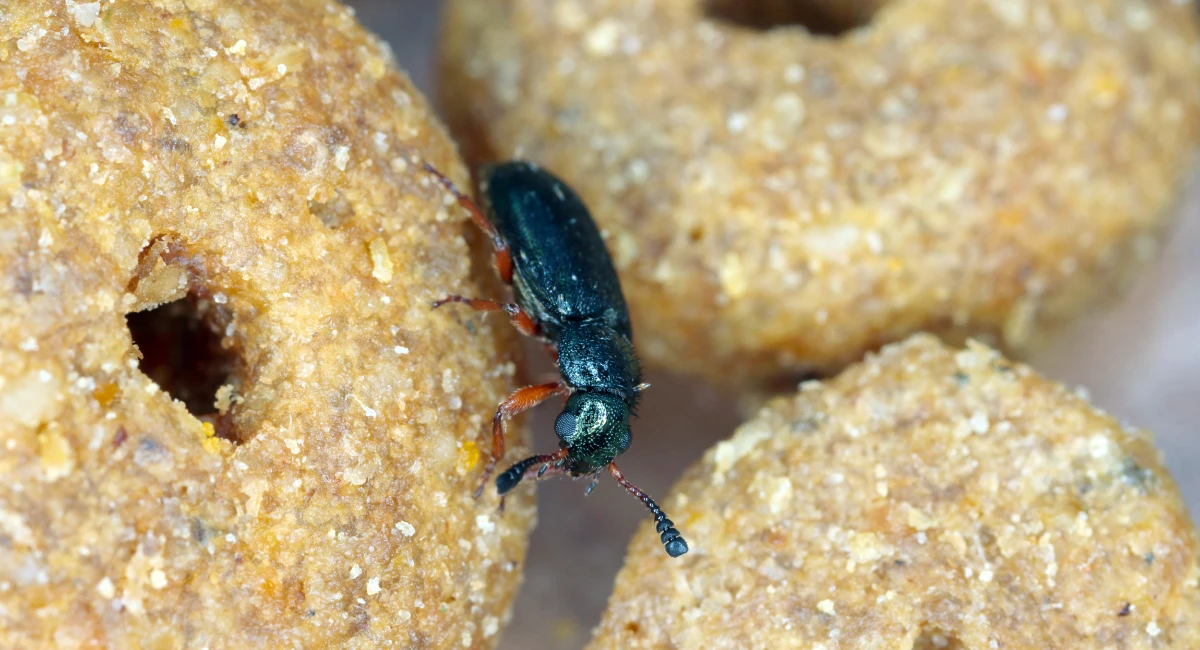
  • Copra beetles are about 10 - 13 mm long as adults length. 
  • The upper surfaces of the body are a shiny metallic bluish-green. The underside of the abdomen is dark blue. Their legs are bright reddish-brown or orange. The antennae are reddish–brown with a dark brown or black club at the tip.

  • Females lay up to 30 eggs per day in cracks or crevices of cured fish. The eggs take between 4 and 6 days to hatch. 
  • The larvae will grow for 30 - 140 days, become less active and look for a dark place to pupate. 
  • The pupal stage varies between 6 - 21 days. 
  • An adult will mate soon after emerging from its pupal stage and can live for up to 14 months.

  • The adults fly and can therefore easily disperse to new sources of food. 
  • They are destructive in both the larval and adult stages, although the larval stage is the most destructive. 
  • They are also cannibalistic, preying on their own eggs and pupae.

Contact us

* Required fields

Kirimkan saya update menarik seputar penawaran dan promosi Rentokil via newsletter

Stored Product Insect Net (SPIN)

Learn more about stored product insect control using specially designed nets to safeguard your commodities and prevent pests from spreading to other areas.

Get in touch

Commercial pest control

Rentokil provides industry-specific commercial pest management solutions to keep your business pest-free.