© 2026 Rentokil Initial plc and subject to the conditions in the Legal Statement - Philippines.
The food trade has enormous impact on both the health of populations and the economies of nations.
Organizations from the UN to world trade bodies, national governments and processors accept that people have the right to expect a high standard from food. At the same time they need to ensure trade does not have so many restrictions that it becomes too burdensome.
World food trade
The volume of world food trade is valued between US$300–400 billion, according to FAO.
With the increasing urbanisation of populations, even developing countries are becoming more reliant on global trade and food processing for their supply of food.
It is important that in the long supply chains from farm to consumer food is kept safe, of good quality and suitable for consumption.
Impact on Businesses

These requirements impact business sectors like food processors and producers in every country as consumers are demanding better safety and quality. Producers and processors exporting food to other countries are subject to their own national regulations and also the strict enforcements of standards and regulations of the major importing countries.
The implementation of food safety involves a complex mix of laws, standards and accepted good practices, involving governments, international organisations (e.g. WTO), industry organisations (e.g. GFSI, BRC), research agencies, independent standards bodies (e.g. BRC, IFS) and independent certification bodies.
Codex Alimentarius
The global reference point for food producers, processors, consumers, national food safety agencies and the international food trade is the Codex Alimentarius, first drawn up by the FAO and WHO in 1961 and managed by the Codex Alimentarius Commission.
The importance of Codex Alimentarius was recognised in the 1985 United Nations Resolution 39/248:
"Governments should take into account the need of all consumers for food security and should support and, as far as possible, adopt standards from the Food and Agriculture Organization of the United Nations and the World Health Organization Codex Alimentarius..."
Global reference point for food safety and quality
It has become the global driver for harmonisation of practices and standards among national bodies, for food safety and quality and also international trade. Its standards are recognised by the World Trade Organisation (WTO) for the settlement of trade disputes.
The Codex has stimulated countries to introduce new food legislation and Codex-based standards, and to establish or strengthen agencies responsible for monitoring compliance with regulations.
Food Safety Legislations and Standards
Ever-tightening policies and regulations today make it essential for companies handling food to take appropriate measures and proactive approach in early detection to control pests in food and food supplies.
Rentokil is your professional partner when it comes to controlling pest risks in compliance with the Philippines food safety legislations and industry best practice and statutory obligations.
- Food Act 1983
- Food Regulation 1985
- Food Hygiene Regulation 2009
Why the Need for Food safety standards?
Food safety standards help companies establish good manufacturing processes so they can produce safe products that comply with food safety legislation and meet quality levels expected by consumers.
They are generally formulated by independent bodies such as BRC and IFS, adopted by food processing businesses and checked by certified accreditation bodies.
Global Food Safety Initiative
The Global Food Safety Initiative (GFSI) is a body set up by the world’s leading retailers and manufacturers in 2000 to provide thought leadership and guidance on food safety management systems.
GFSI facilitates collaboration between the food safety experts from retail, manufacturing and food service companies, and also international organisations, governments, academia and service providers to the global food industry.
A benchmark for food safety standards
GFSI creates the benchmark for food safety standards and gives approval to those that reach its ‘standard for standards’.
The BRC Global Standard for Food Safety was the first to be approved by GFSI and is the most widely used worldwide. This sets out seven sections for an effective food safety system:
- Senior management commitment and continual improvement.
- The Food Safety Plan: HACCP (hazard analysis and critical control point) program based on the requirements of the Codex Alimentarius system.
- Food safety and quality management system: product specifications, supplier approval, traceability, and the management of incidents and product recalls. This builds on the principles of ISO 9000.
- Site standards: layout and maintenance of the buildings and equipment, cleaning, pest control, waste management and foreign body control.
- Product control: product design and development including allergen management, product and ingredient provenance, product packaging and product inspection and testing.
- Process control: safe process controls, weight/volume control, equipment calibration, ensuring the HACCP plan is implemented.
- Personnel: standards for staff training, protective clothing and personal hygiene.
Rentokil Initial and BRC Global Standards have formed a strategic partnership to enable ongoing collaboration and development of new initiatives in risks mitigation and improve best practices in the food industry.
Hazard Analysis & Critical Control Point
HACCP (Hazard Analysis and Critical Control Point) is a systematic approach to food safety that focuses on preventing contamination from biological, chemical, physical and radiological hazards.
HARPC (Hazard Analysis and Risk-Based Preventive Controls) is a recent adaptation for certain businesses in the USA that come under the Food Safety and Modernization Act.
HACCP was first developed for the design and manufacture of food for the US space programme.
The hazards include bacteria, viruses, natural toxins, pesticides, drug residues, decomposition, parasites, allergens, unapproved food and colour additives, and radioactive compounds.
HACCP is used at all stages of food production, from raw material production, procurement and handling, to manufacturing, distribution and consumption of the finished product. Each food processing or handling business must develop an HACCP system and tailor it to its individual product, processing and distribution conditions.
The 7 principles of HACCP
The seven principles of HACCP are accepted by government agencies, trade associations and the food industry around the world. These principles are:
- Conduct a hazard analysis.
- Identify critical control points (CCPs).
- Establish critical limits for critical control points.
- Establish monitoring procedures.
- Establish corrective actions.
- Establish verification procedures.
- Establish record-keeping and documentation procedures.
GMP (good manufacturing practice)
GMPs describe the methods, equipment, facilities, and controls for producing processed food to produce high quality and safe products and are generally specified in regulations. In the US GMPs are written into the food regulations by the FDA. The regulations address personnel, buildings and facilities, equipment and utensils, and production and process controls.
GMPs, along with standard operating procedures (SOPs), form the basis for HACPP and the ISO9000 quality management standard. They are often visualised as a pyramid of dependencies.
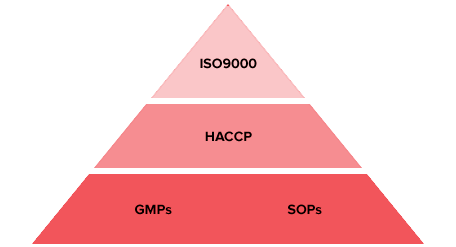
Figure: The foundation of HACCP and ISO9000
Source: University of Nebraska (www.foodsafety.unl.edu/haccp/prerequisites/gmp.html)
Bibliography
Food Standards Agency. Food Hygiene. A Guide for Businesses. London, Food Standards Agency, 2013
Overview of HACCP Principles. University of Nebraska – Lincoln.
www.unl.edu
FDA. Food Safety Modernisation Act.
www.fda.gov/Food/GuidanceRegulation/FSMA
North Dakota State University. Food Law. International Considerations.
www.ag.ndsu.edu/foodlaw/international-considerations
European Commission. Food Hygiene Basic Legislation.
ec.europa.eu/food/food/biosafety/hygienelegislation/comm_rules_en.htm
Food guidance regulations
- www.fda.gov/Food/GuidanceRegulation/FSMA/ucm334115.htm
- www.fda.gov/Food/GuidanceRegulation/FSMA/ucm253380.htm
Philippines food guidance regulations
Philippines Republic Act No. 10611 - Food Safety Act 2013
Get in touch
Food Legislation for Pest Control
The ever-tightening policies and regulations make it essential for companies handling food today.