myRentokil
myRentokil login© 2026 Rentokil Initial plc (M) Sdn Bhd Registration No: 197201001250 (12889-M). Subject to the conditions in the Legal statement
Flies and other flying insects pose a significant threat to businesses that demand contamination-free environments, such as those that involve the handling of food or pharmaceuticals. They also present a nuisance in customer-facing areas, such as hotels and eateries.
Every business needs an effective solution for removing flies that is suitable for its specific environment, whether it be a large warehousing facility or a café. There are various factors for a business to consider when selecting an insect light trap (ILT).
While traditional ILTs may be effective at eliminating flies, LED ILTs offer equal, if not superior, efficacy and bring a host of additional benefits.
Energy Savings
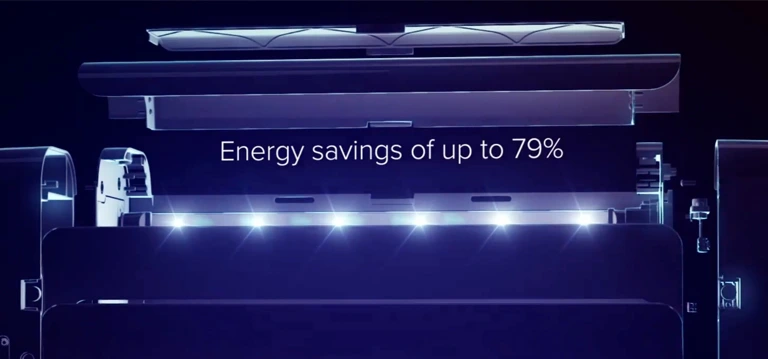
It is no secret that typical LED bulbs used in homes offer significant energy savings compared to conventional light bulbs, this holds true for conventional fluorescent bulbs used in Insect Light Traps (ILTs) as well. A typical LED strip in an ILT utilises only 10 Watts of power, contrasting with the 30–90 Watts consumed by units with fluorescent tubes. In our tests, a Lumnia ILT with Lumnia LED lamps demonstrated a potential power savings of up to 79%, compared to equivalent traps with fluorescent tubes.
LED lamps also allow for variable light output by reducing power, enabling even more energy savings compared to fluorescent tubes. The contrast in light output with the surroundings is crucial for attracting flies, so during night and low-light conditions, the power and output of our Lumnia LED lamps can be diminished while still effectively attracting flies.
Lumnia units feature day and night modes, further reducing power consumption when least needed, enabling businesses to save more and further decrease their environmental footprint.
Longer life
LED lamps also allow for variable light output by reducing power, enabling even more energy savings compared to fluorescent tubes. The contrast in light output with the surroundings is crucial for attracting flies, so during night and low-light conditions, the power and output of our Lumnia LED lamps can be diminished while still effectively attracting flies.
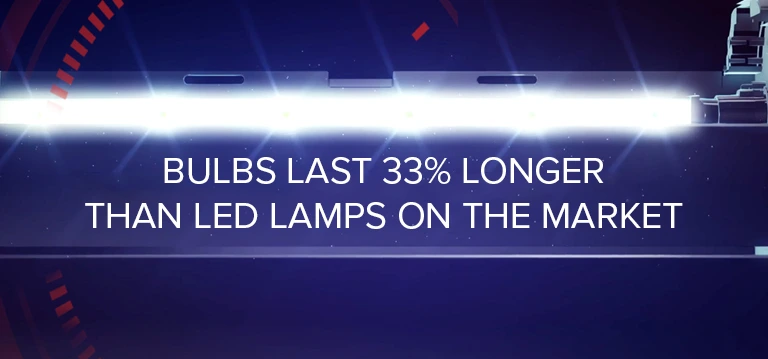
The standard fluorescent tubes used in insect light traps typically last about a year before needing to be replaced. During this time, the UV light output diminishes to only half of the original brightness. Lumnia LED lamps, on the other hand, produce UV light for a minimum of four years and the brightness only drops to 70% of the original output.
Lumnia LED lamps not only have a lifespan four times longer than fluorescent tubes, thereby reducing replacement costs, but they also maintain a higher UV light output over that extended period, ensuring prolonged effectiveness.
The UV output of our LED lamps is approximately 80% greater than that of conventional L3 fluorescent tubes used in ILTs. This means that even after four years of use, the UV output of LEDs remains equivalent to that of a new L3 fluorescent tube.
No hazardous chemicals
Fluorescent lamps use hazardous chemicals, including low-pressure mercury vapour and gases like argon, xenon, neon, or krypton, to generate light. The glass tube inside is coated with a fluorescent substance made from metallic and rare earth phosphor salts, converting UV light from mercury into desired wavelengths. In contrast, an LED lamp contains a small semiconductor wafer enclosed in plastic, with several placed on a strip for use in an ILT. Therefore, LED lamps do not have hazardous chemicals that can escape during normal use.
No glass
A fluorescent tube consists of a fragile glass tube that contains the mercury vapour and the other components mentioned above. The glass tube can easily shatter if dropped or receives an impact, which would scatter glass and other chemicals in the tube around the area where food is handled. In a Lumnia LED lamp, there is no glass or hazardous chemicals in a form that could be scattered in a food-handling area. In tests in which a Lumnia ILT is dropped repeatedly, the lamps don’t break, so they are perfectly safe for a food environment.
Hygiene
With some electric traditional fly-traps, flies are zapped and their fragments can escape into the environment, leading to contamination risks in food-handling areas. Lumnia units for high-dependency areas are designed to overcome this by using powerful glue boards and an encapsulation module that captures flies and prevents insect fragments from escaping. This minimises the risk of cross-contamination, making fly control more hygienic.
The graph shows the sensitivity of the photoreceptors in a house fly’s eyes to different wavelengths of light. This shows that the fly’s photoreceptors are tuned to wavelengths around 350 nanometres, which is close to the UV output of the Lumnia LEDs (365 nm).
LED lamps produce intense light in the most sensitive part of the UV spectrum that flies can see. There is little UV light in indoor environments, therefore, the LED lamps will appear to the flies as bright sources of light and attract them to the unit.
The greater brightness of the LED lamps also means the ILT has a greater reach – the distance at which the light is bright enough to attract insects. In testing our Lumnia ILTs, the reach of the LED lamp strip was determined to be 80% greater (UV light measured in watts per square metre on a flat surface) than a traditional L3 fluorescent tube.
An LED lamp will attract flies and other insects at greater distances, which also means that in a large space, fewer units are required as they can be placed further apart. This saves costs for businesses threefold – in the number of ILTs, electricity costs and lamp replacement.
With some electric traditional fly-traps, flies are zapped and their fragments can escape into the environment, leading to contamination risks in food-handling areas, for instance.
Lumnia units for high-dependency areas are designed to specifically overcome this by using powerful glueboards and an encapsulation module that captures flies and prevents the insect fragments from blowing out. These minimise the risk of cross-contamination, making fly-control more hygienic.
When compared to traditional fly-traps, Lumnia LED ILTs are not only just as or more effective, they’re more cost-effective, sustainable and hygienic. However, it’s the Lumnia range from Rentokil that boasts a greater reach and catches flies faster than any other LED ILT. And with their modern design, they’re aesthetically pleasing enough to go into front-of-house locations, too.
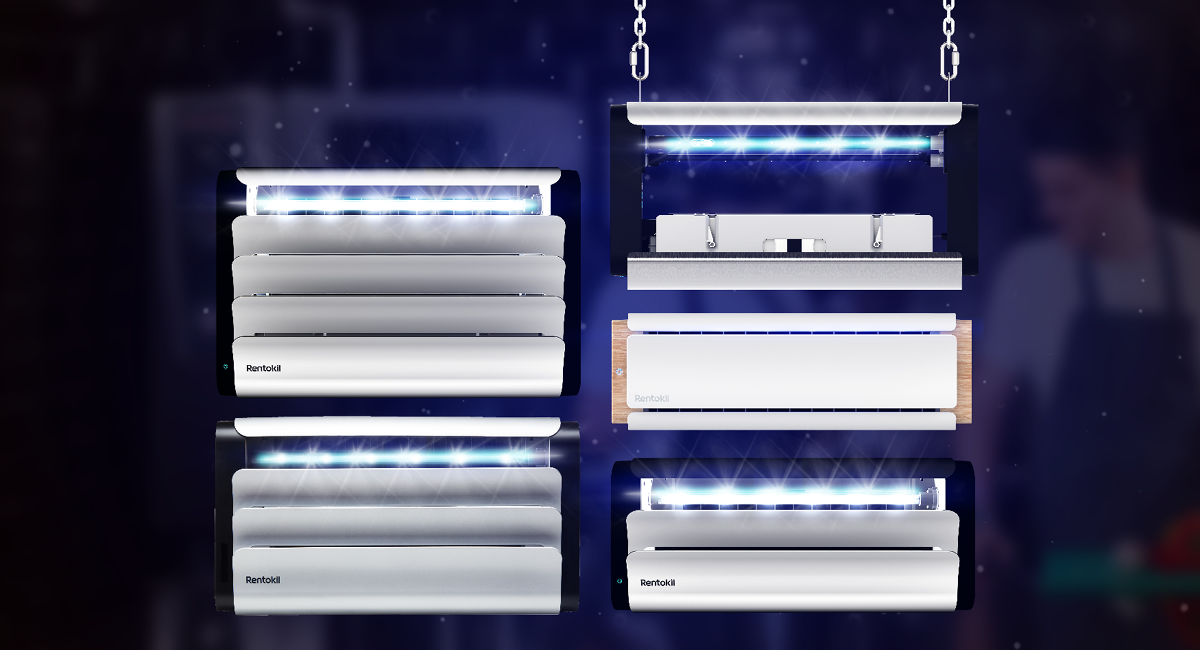
When compared to traditional fly traps, Lumnia LED ILTs aren’t only more effective but also cost-effective, sustainable and hygienic. It's the Lumnia range from Rentokil that boasts a greater reach and catches flies faster than any other LED ILT. And with their modern design, they’re aesthetically pleasing enough to be placed at front-of-house locations too.
Professional, discreet fly elimination services, keeping your business premises safe and hygienic.