© 2026 Rentokil Initial plc and subject to the conditions in the Legal Statement.
Get in Touch
Contact an Expert
Think You’ve Seen One of These Termites?
You need a Termite Inspection
There are 300 different species of termites in Trinidad, but only a handful cause problems to properties. Of these, the Coptotermes species is considered to be the most destructive in Trinidad and Tobago, causing major destruction to countless properties every year. It is a subterranean termite that favours damp, tropical areas. They generally do not build mounds although some have been found in forested parts of the islands. They mostly nest in trees, stumps, poles, or verandahs where timber has been buried. They attack all timber structures and damage forest and ornamental trees, as well as fruit trees.
Soil contact is desirable for this species, but not essential, provided that it has an assured moisture supply and security in its habitat. Colonies have been found on top of multistory buildings where there is a constant water supply, but no ground contact. Large colonies have also been found inside wooden barges that do not have contact with the ground, moisture being supplied through the timber from the fresh or salt water. This species has also been known to cause fire by shorting electrical wiring. In a Sydney hospital, the wiring was so severely damaged it caused an electrical black-out to a large and sensitive part of the hospital.
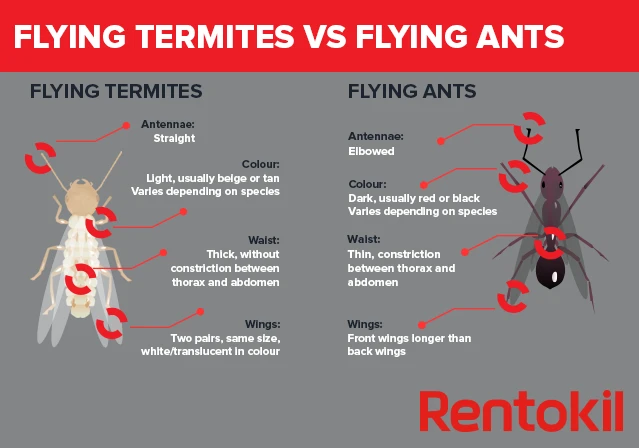
Subterranean termites (those most commonly seen in homes) are a similar size to black ants but they are paler in colour, often being called “white ants”. If you look closely, termites have two sections to their body while ants have three. You may also notice termites with wings, called alates. Sometimes confused for moths, the alates fly out from the colony in search of a new environment in which to reproduce and develop a new colony.
Important Termite Facts